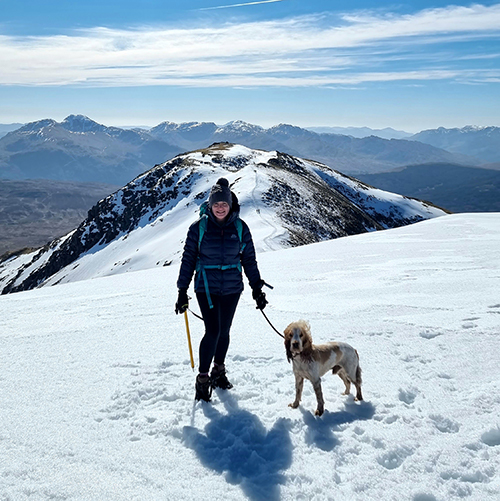
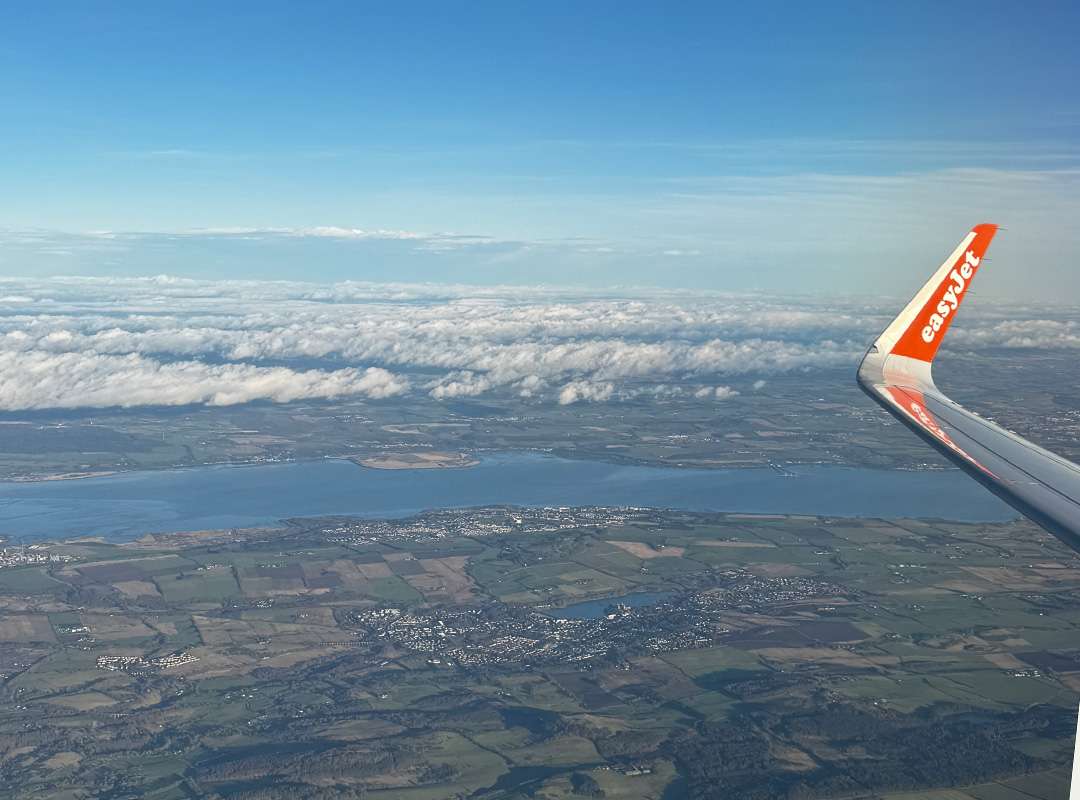
There is a saying in Scotland that ‘west is best’ and yes, there’s something truly magical about Scotland’s west coast, where the sea stretches on forever, the beaches are some of the best in the world and the seafood is to die for.
The coast stretches from the Rhinns of Galloway in the south to Cape Wrath in the far north, a coastline of sea lochs, white sand beaches, mountain ranges dropping straight into the sea, scattered islands and remote peninsulas.
It’s also huge. You can’t see it all in one trip. This guide splits the west coast into regions from south to north, with my favourite places to visit in each, so you can plan a trip that matches the time you have.
How to use this guide
The west coast divides naturally into regions, and this guide works from south to north. Jump to whichever section you’re planning around.
- Dumfries & Galloway — the Rhinns of Galloway and Scotland’s southernmost coast
- Argyll: the Mull of Kintyre — Tarbert, Campbeltown and whisky country
- Argyll: Cowal, Loch Fyne and Inveraray
- Argyll: Oban, Crinan and the Slate Islands
- The Inner Hebrides — Mull, Iona, Islay, Jura and the smaller islands
- The West Highlands: Glencoe, Fort William and Ardnamurchan
- The Rough Bounds: Arisaig, Morar, Glenelg and Knoydart
- Skye and the Small Isles
- Wester Ross — Plockton, Applecross, Torridon and Gairloch
- The North-West Highlands — Ullapool, Assynt, Kylesku and Cape Wrath
- Suggested itinerary: an 8-day road trip
- Practical information — when to visit, how long to spend, how to get around
- Frequently asked questions
Which section of the west coast of Scotland is right for you?
A few quick pointers before the regional tour, because the west coast isn’t one place and different regions suit different trips.
- If you have a long weekend, pick one region. Argyll (Oban, Crinan and the Slate Islands) is easy to reach from Glasgow. Wester Ross works well from Inverness.
- If you have three or four days, base yourself in one village and use it as a hub. Plockton, Lochinver and Tobermory all work for this.
- If you have a week, combine two adjacent regions. Glencoe + Ardnamurchan works. Applecross + Assynt works. Argyll + Mull works.
- If you have two weeks, you can drive the length of the west coast from Glasgow to Cape Wrath, with time for ferries to the islands.
Dumfries & Galloway: the Rhinns of Galloway
The Rhinns of Galloway is a 25-mile peninsula in the south-west corner of Scotland, stretching from Corsewall Lighthouse in the north to the Mull of Galloway in the south. It’s sparsely populated, mostly farmland, and has a mild climate that lets palm trees grow in the gardens.
This is the quietest part of the west coast. Tourists don’t often make it this far south, which means the beaches are empty, the villages unspoiled, and accommodation easier to book.
Portpatrick is the prettiest harbour town, with pastel-coloured houses wrapped around a sheltered bay. It’s the start of the Southern Upland Way, Scotland’s long-distance coast-to-coast walking route.
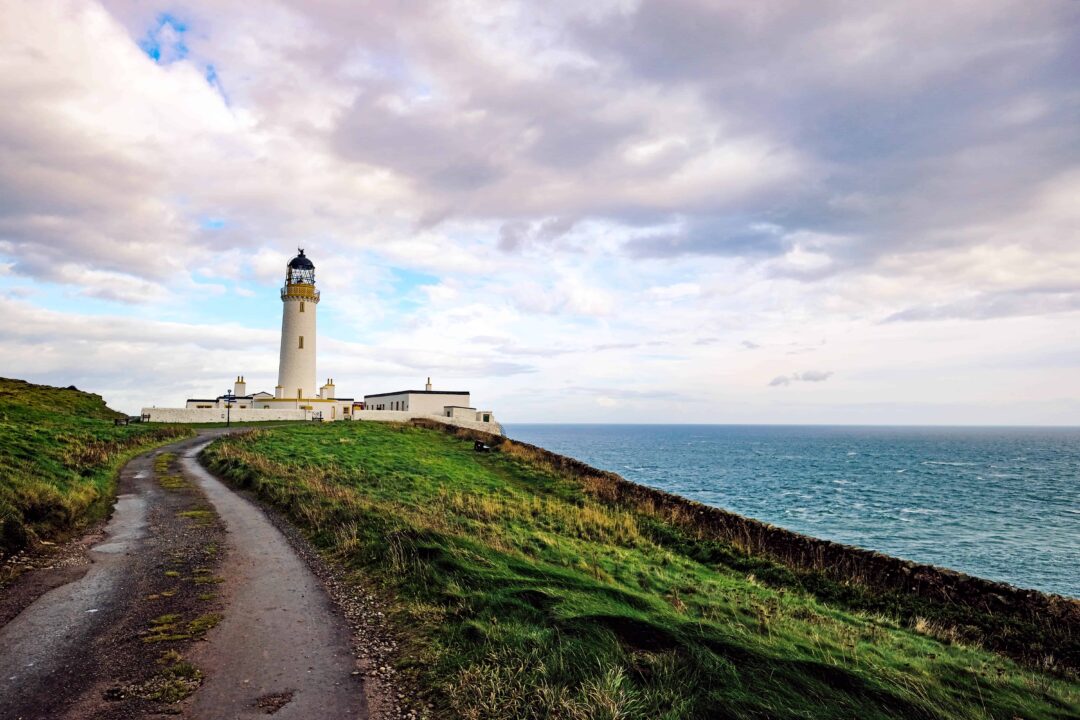
The Mull of Galloway is Scotland’s most southerly point. The Mull of Galloway Lighthouse has 100 steps to the top and the RSPB reserve cameras show seabirds and dolphins. On a clear day, you can see Ireland, the Isle of Man and the Lake District from the top.
Logan Botanic Garden is the most exotic garden in Scotland, with palm trees, tree ferns, koi carp and the ruins of a castle. It’s part of the Royal Botanic Garden Edinburgh. The cafe is good for lunch. Trivia: the gardens were used as a filming location for The Wicker Man.
Stay at Corsewall Lighthouse at the northern tip of the peninsula, a working lighthouse you can stay in.
Read more: my guide to Dumfries and Galloway.
Argyll: the Mull of Kintyre
The Mull of Kintyre is the long peninsula immortalised in Paul McCartney’s song, stretching 40 miles south of Tarbert. It separates the Atlantic from the Firth of Clyde and was once the Kingdom of Dál Riata, the cradle of Scotland’s Gaelic heritage.
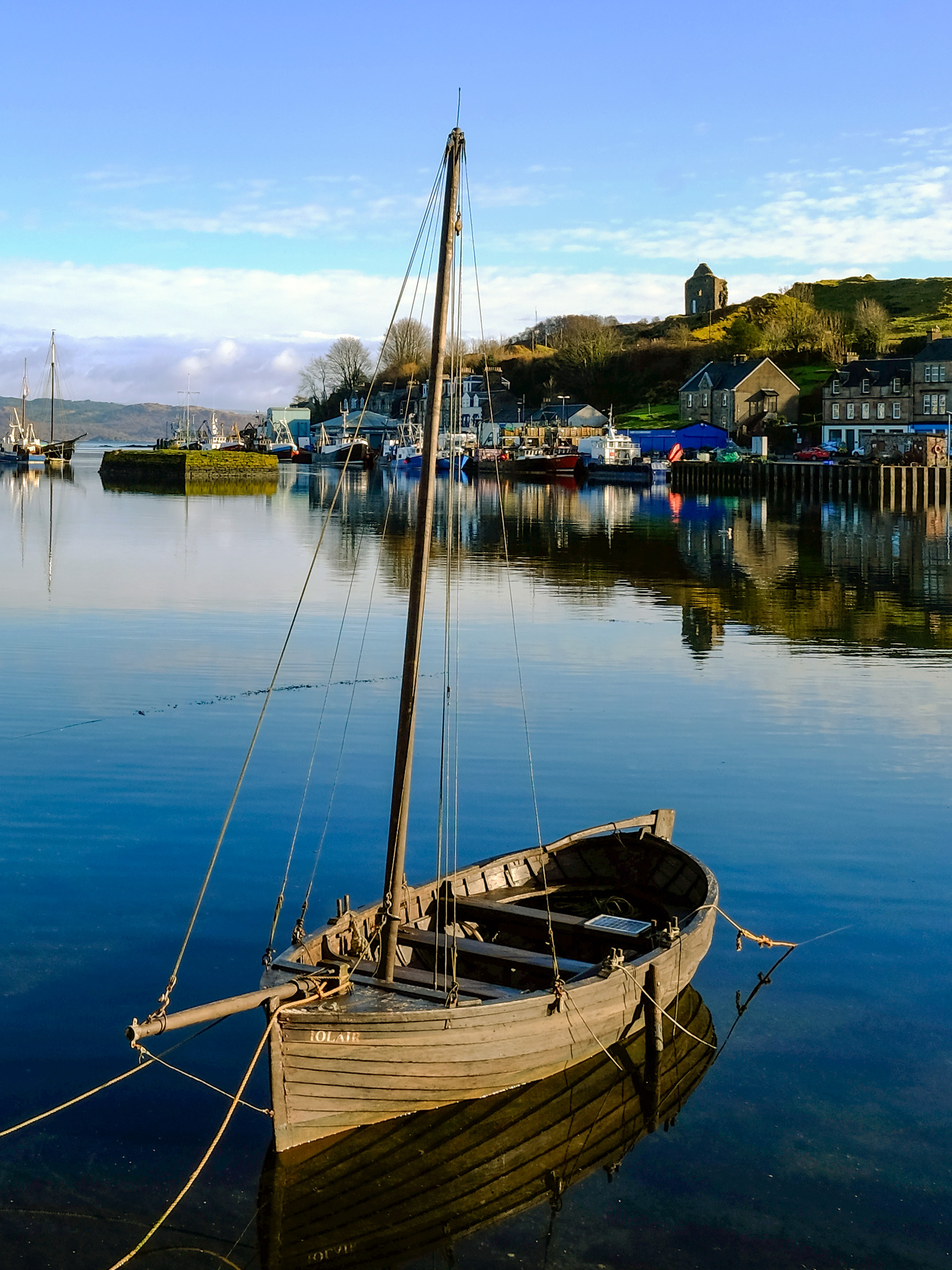
Tarbert sits at the top of the peninsula on a narrow isthmus between two sea lochs. The harbour is pretty, the ruined castle on the hill above the town is worth a climb for the view, and the Stonefield Castle Hotel is a grand baronial pile in woodland gardens on the outskirts.
Campbeltown is the Mull’s main town and was once called the whisky capital of the world — at its peak in the 1800s it had over 30 distilleries. Now it has three: Springbank, Glen Scotia and Glengyle. Springbank and Glengyle are owned by the Mitchell family, and Springbank is the one most whisky enthusiasts travel here for.
Kilmartin Glen, halfway up the peninsula, is one of Scotland’s richest archaeological landscapes, with over 350 prehistoric monuments in a six-mile stretch. Cairns, stone circles, standing stones and cup-and-ring marked rocks. The Kilmartin Museum is small but excellent.
Machrihanish, on the Atlantic side near Campbeltown, has three miles of beach and the Ugadale Hotel. Worth visiting for the sunset.
Stay at The Ugadale Hotel in Machrihanish or the Ashbank Hotel in Carradale.
Argyll: Cowal, Loch Fyne and Inveraray
North of the Mull of Kintyre, you cross into Cowal and the Loch Fyne region. The A83 is the main road, climbing over the Rest and Be Thankful pass between Arrochar and Inveraray. It’s one of Scotland’s classic drives, though prone to landslides.
Inveraray is a planned Georgian town on the shore of Loch Fyne, designed in the 1740s by the Duke of Argyll when he moved the old settlement to build his new castle. The white-washed buildings, the loch frontage, and the grand church at the head of the main street make it one of the prettiest towns in Argyll.
Inveraray Castle is still the seat of Clan Campbell and the Duke of Argyll. It’s open to the public in summer. Inveraray Jail, the Victorian courthouse and prison, is a proper museum with costumed interpreters. Grab fish and chips by the loch and eat them on the pier.
Loch Fyne itself is famous for its oysters. The Fyne Ales Brewery at the head of the loch does good pies and pints, and their beer Jarl has won awards.
The Cowal Peninsula sits between Loch Fyne and the Firth of Clyde. Puck’s Glen is a fairy-tale ravine walk near Dunoon, with a waterfall, mossy boulders and wooden bridges. Short, easy, and one of the best woodland walks in Argyll.
Crarae Garden is a National Trust woodland garden on Loch Fyne with Himalayan rhododendrons, wild azaleas, and a gorge. Best in late spring.
Stay at the Loch Fyne Hotel, a dog-friendly spa hotel on the lochside, or Brambles of Inveraray in the town centre.
Read more: my guide to Inveraray and Puck’s Glen in the Cowal Peninsula.
Argyll: Oban, Crinan and the Slate Islands
Oban calls itself the seafood capital of Scotland and the gateway to the isles, both of which are earned. It’s the main west coast ferry port, with CalMac services to Mull, Colonsay, Coll, Tiree, Barra and South Uist.
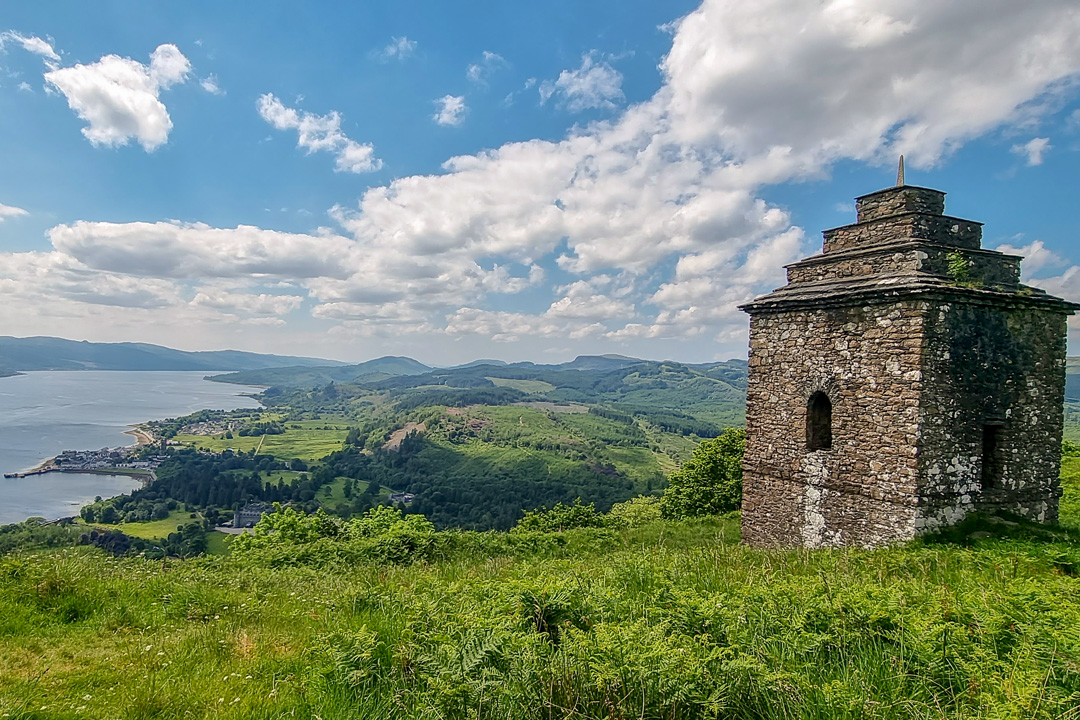
Oban itself is a busy Victorian resort town wrapped around a harbour. McCaig’s Tower, the colosseum-like folly on the hill above, is worth the steep walk up for the view over the harbour and across to Mull. Good seafood restaurants, a distillery in the town centre, and a working fishing harbour make it a proper west coast town rather than a tourist trap.
For lunch, Cuan Mor does proper pub food and good beer. The Green Shack on the harbour is the Oban institution for cheap fresh seafood, eaten on a bench looking at the boats.
Castle Stalker, on a tiny tidal island in Loch Linnhe north of Oban, is one of Scotland’s most photographed castles and a Monty Python filming location.
Crinan
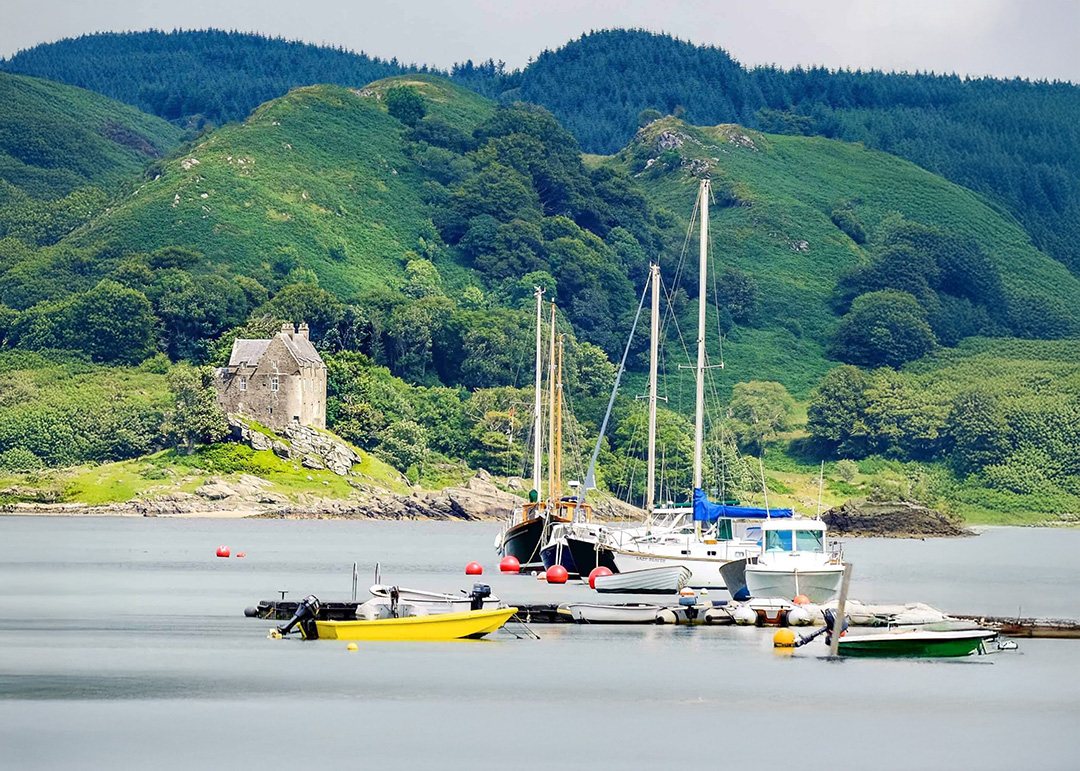
Crinan, south of Oban, is a tiny village at the end of the Crinan Canal where the canal meets the Sound of Jura. It’s known as “Britain’s most beautiful shortcut” because the canal lets small boats cross from Loch Fyne to the Atlantic without going around the Mull of Kintyre. Walk the Castle Dounie circular for the best views of the Sound of Jura.
The canal was opened in 1908 to provide a fast route across Scotland from Glasgow to Oban, bypassing the route around the often dangerous Mull of Kintyre. The fastest route from Glasgow to the Highlands of Scotland used to be taking a Clyde Puffer from Crinan up Loch Linnhe to Fort William where you would join the Caledonian Canal to Inverness!
Stay at: The Crinan Hotel which is located in the village of Crinan or go self catering at Winterton, or Printmakers Cottage.
Read more: my guide to sailing the Crinan Canal.
The Inner Hebrides
The west coast isn’t just the mainland. The Inner Hebrides sit just offshore and most of them are accessible by ferry from Oban, Kennacraig or the Ardnamurchan peninsula.
Mull
Mull is the big one. Dramatic scenery, the only Munro on an island south of Skye (Ben More), and the colourful harbour town of Tobermory. From Tobermory you can catch boats to Iona, Staffa and the Treshnish Isles to see puffins.
The white sands of Calgary Bay on Mull’s west coast are some of the most photographed in Scotland.
Read more: my 24 hours on the Isle of Mull guide.
Iona
Iona is the small island off the south-west corner of Mull where St Columba landed in 563 AD and founded a monastery that converted much of Scotland to Christianity. Iona Abbey still stands, fully restored, and 48 Scottish kings are buried in its graveyard, including Macbeth and Duncan. The island is two miles by one mile, and can be walked end to end in an afternoon. No cars for non-residents.
Staffa
Staffa is the basalt-columned island that inspired Mendelssohn’s Hebrides Overture and gave its name to the Giant’s Causeway formation. Fingal’s Cave is the sea cave with the columnar walls. Boat trips run from Mull and Iona in summer.
Islay and Jura
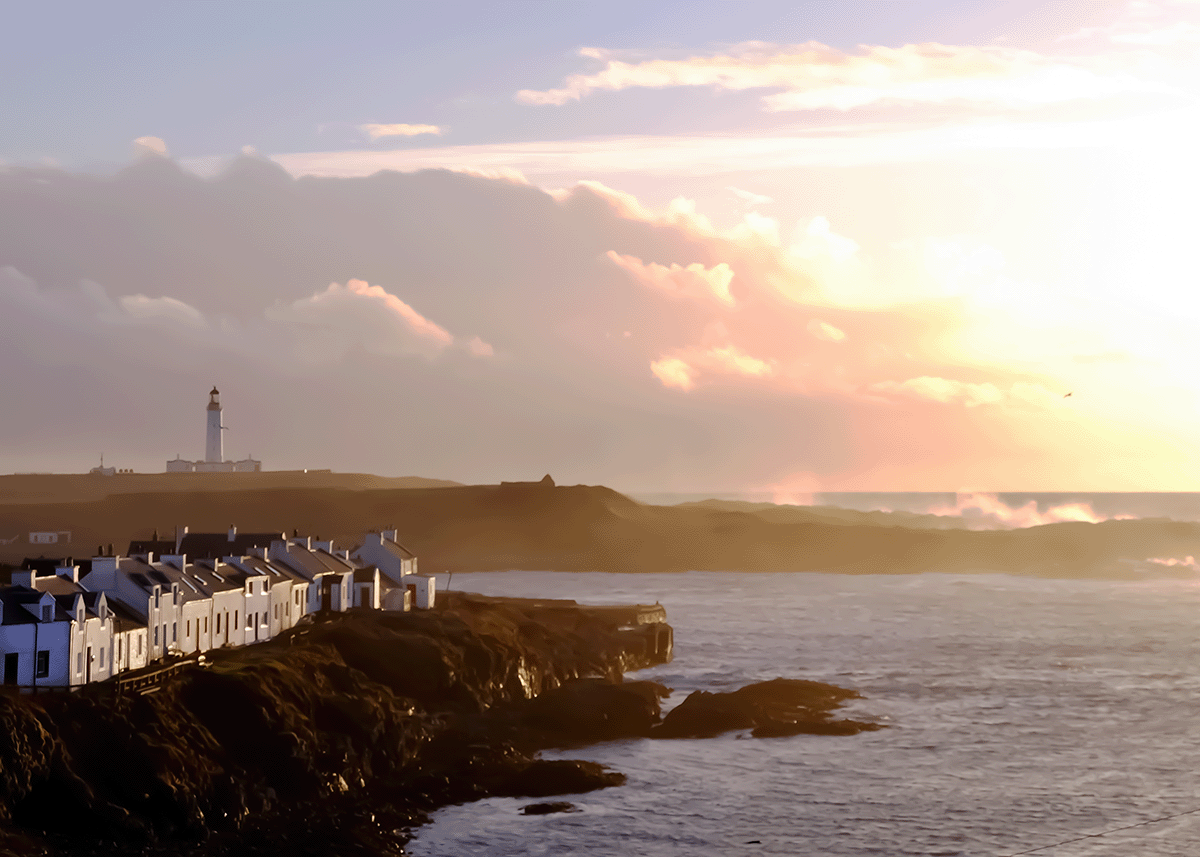
Islay is the whisky island, with a growing number of distilleries including Ardbeg, Laphroaig, Lagavulin, Bowmore and Bruichladdich.
Jura, a short ferry ride from Islay, is quieter. One distillery, three Paps of Jura mountains, red deer outnumbering humans 30 to one, and George Orwell’s old house where he wrote 1984. The Corryvreckan whirlpool off the north coast is the third-largest whirlpool in the world.
Read more: my guide to Islay.
The West Highlands Peninsulas and Ardnamurchan
Ardnamurchan feels like the edge of the world. Scotland’s most westerly point, it’s reached by single-track roads that snake alongside sea lochs, across volcanic moorland and ancient forest before arriving at the ‘headland of the great seas’ battered by Atlantic waves.
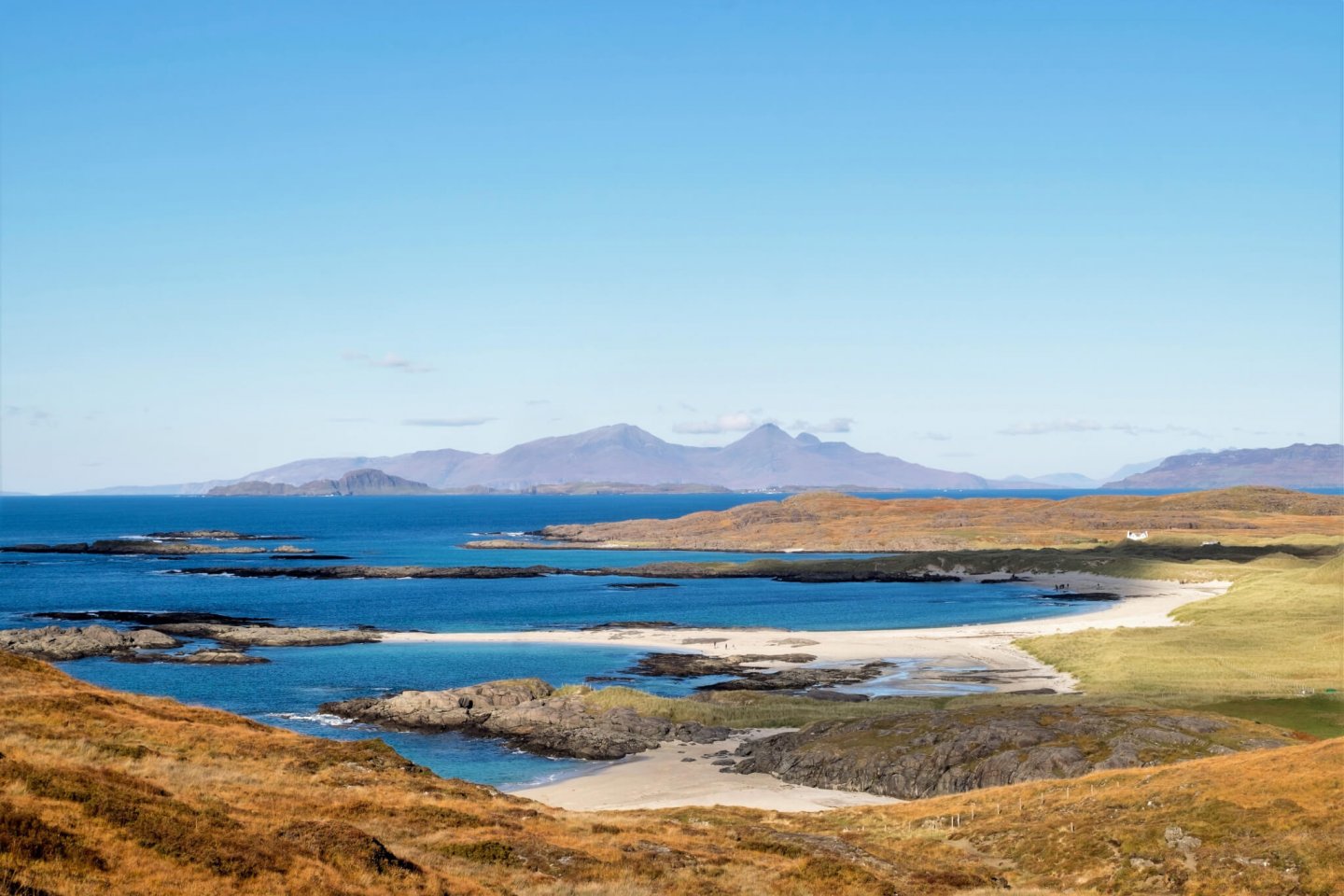
At Ardnamurchan Point, a lighthouse marks the western edge of Scotland. One of my favourite beaches in the world, Sanna Bay, is just up the road and has incredible views of the dramatic An Sgurr and Rum Cullin – and white sands and turquoise waters.
The peninsula is home to two distilleries, the Ardnamurchan Distillery which is one of my favourite drams and Nc’Nean is organic and female owned and run. Further afield is Castle Tioram which sits on its own tidal island and Glenfinnan and the Jacobite Express travel to Mallaig from Fort William just to the north.
Stay at: Dondie’s House, Kilchoan, Volcano Cabins, the wonderful Mingary Castle – Restaurant with Rooms, a grass roofed cottage in Acharacle, Birch and Oak Lodges.
Read more: my guide to Ardnamurchan.
The Rough Bounds: Arisaig, Morar, Glenelg and Knoydart
North of Ardnamurchan and west of the Great Glen lies the area known historically as the Rough Bounds. Arisaig, Morar, Knoydart and Glenelg. This is some of the wildest country in Scotland, with single-track roads, empty beaches, and communities only reachable by boat.
Arisaig and Morar
The coastline between Arisaig and Mallaig is called the Silver Sands of Morar, a run of white-sand beaches backed by dunes, with views to Rum, Eigg and Skye. Camusdarach Beach was the filming location for Local Hero. The beaches are genuinely world-class and considerably less busy than anything on Skye.
Mallaig at the end of the road is the ferry port for Skye, the Small Isles and Knoydart. It’s a working fishing port, so lunch is seafood-straight-off-the-boat.
Glenelg
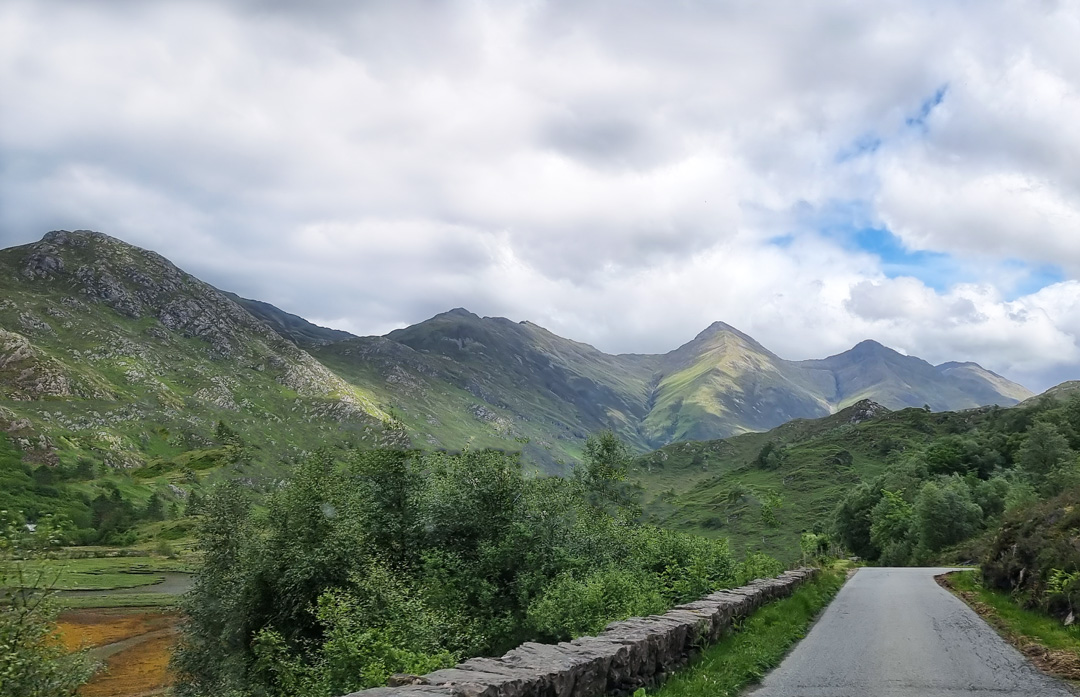
Over the Mam Ratagan pass from Shiel Bridge, the tiny village of Glenelg sits on the Sound of Sleat opposite Skye. The view from the top of the pass over Loch Duich to the Five Sisters of Kintail is one of the finest in Scotland.
Glenelg has three well-preserved Iron Age brochs (Dun Telve, Dun Troddan and Dun Grugaig) and the Skye Ferry, the last hand-operated turntable ferry in the world, which runs across the Sound of Sleat in summer.
One of the most beautiful spots on the peninsula is Sandaig Bay, once home to Scottish naturalist Gavin Maxwell who lived there with his otters Mijbil, Edal, Teko, Mossy and Monday at Camusfearna, a story that was made into a film in 1969.
Stop at the friendly Glenelg Inn for lunch.
Stay at: the incredible tree tent highland hangout, Ratagan Youth Hostel, for self catering stay at Roddy’s Cottage, Seaview or Skye View or Rams Cottage, or for B&B, Kirkton Bay House Bed and Breakfast.
Read more: my guide to Glenelg.
Loch Hourn and Knoydart
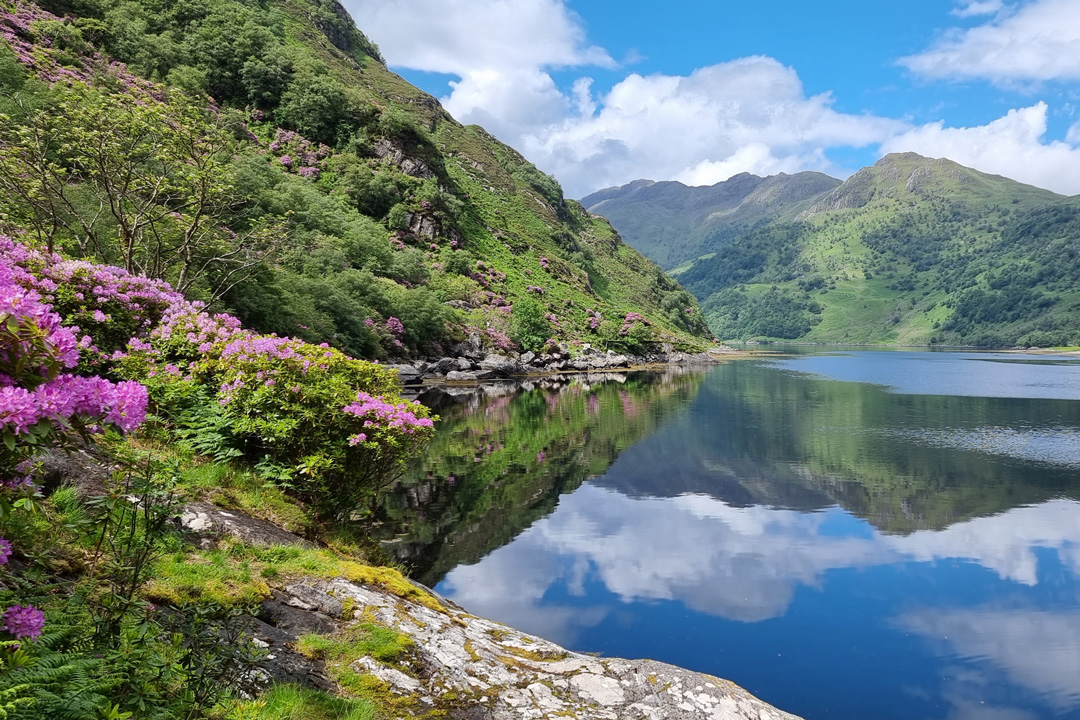
Loch Hourn cuts deep into the wilds of the west coast, a sea loch like a Scandinavian fjord. The 22-mile drive down to Kinloch Hourn is one of the most hair-raising in Scotland, ending at a dead end where the road gives up.
From Kinloch Hourn you can walk out to Barrisdale Bay and beyond to the village of Inverie on the Knoydart peninsula, home to The Old Forge, the UK’s most remote pub. The full route out to Inverie is 15 miles, and most people stop at Barrisdale for the night on the way out and back. In summer a boat will run you out to Barrisdale, or you can catch the passenger ferry to Inverie from Mallaig.
Stay at: Lochhournhead B&B & Tea Room which is located in the hamlet of Kinloch Hourne itself, further afield stay at The Cluanie Inn, Sheenas Butnben, or Kintail Lodge Hotel..
Read more: my walk at Kinloch Hourn.
Skye and the Small Isles
The Isle of Skye is the biggest and most visited of the Hebrides. It’s connected to the mainland by the Skye Bridge at Kyle of Lochalsh, so you don’t need a ferry to visit.
Skye has the Cuillin mountain range, the Old Man of Storr, the Quiraing, the Fairy Pools, Neist Point Lighthouse, Dunvegan Castle, and Talisker distillery. In summer it’s very busy and in winter it’s very quiet.
Skye deserves its own trip rather than a day visit if you can manage it. Three or four days lets you see the Trotternish peninsula, the Cuillin, and still have time for Dunvegan or Elgol.
If you go, visit sustainably: park sensibly, drive slowly on single-track roads, and book accommodation well in advance. The Sleat peninsula in the south is quieter and often overlooked by the day-trip crowds.
Read more: my guide to the Isle of Skye.
The Small Isles — Rum, Eigg, Muck and Canna — are reached by CalMac ferry from Mallaig. Rum has mountains and red deer, Eigg has the Sgurr and a pioneering community-owned energy scheme, Muck is tiny and peaceful, Canna is home to a pair of Golden Eagles. If you want remote, the Small Isles deliver.
Wester Ross
Wester Ross is the stretch of coast from Kyle of Lochalsh north to the southern edge of Assynt. It has the highest concentration of dramatic mountain scenery on the west coast, and some of the prettiest villages.
Plockton
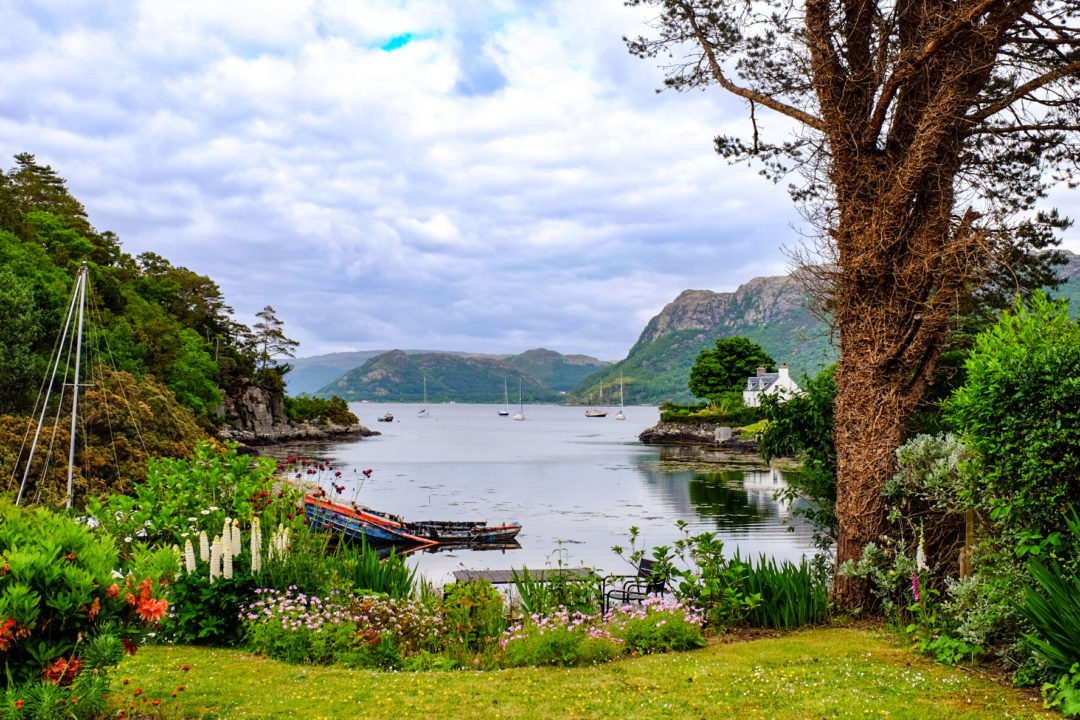
The pretty village of Plockton sits on the shores of Loch Carron as it makes its way out to the Isle of Skye. With a sheltered position, Plockton has such a mild climate palm trees to prosper on the waterfront. It was the setting for the 1990s TV series Hamish Macbeth.
Once famous for its herd of free ranging Highland Coos, the village is now a destination for foodies dining at the Plockton Hotel (Wester Ross & Highland’s Camra pub of the year) which serves a great pint and The Plockton Inn which is renowned for its seafood – making Plockton one of the best towns in Scotland for a weekend break.
Stay in Plockton at The Plockton Inn, or at the Haven Guest House, the Duirinish Pods with hot tubs or self catering at 24 Harbour Street. If you fancy staying in a castle near Plockton, why not check out Duncraig Castle.
Applecross
Applecross is a peninsula reached by one of the most spectacular roads in Britain: the Bealach na Bà. The road climbs from sea level to over 2,000 feet in a series of hairpin bends, with gradients up to 1 in 5. Not for caravans, nervous drivers, or wet winter conditions.
The reward is the Applecross Inn on the Sound of Raasay, known for its seafood and sunset views. The Applecross Walled Garden nearby does lovely lunches.
If the Bealach is closed or you want an easier return, the coastal road north to Shieldaig is longer but gentler.
Read more: my stay at the Applecross Inn.
Torridon
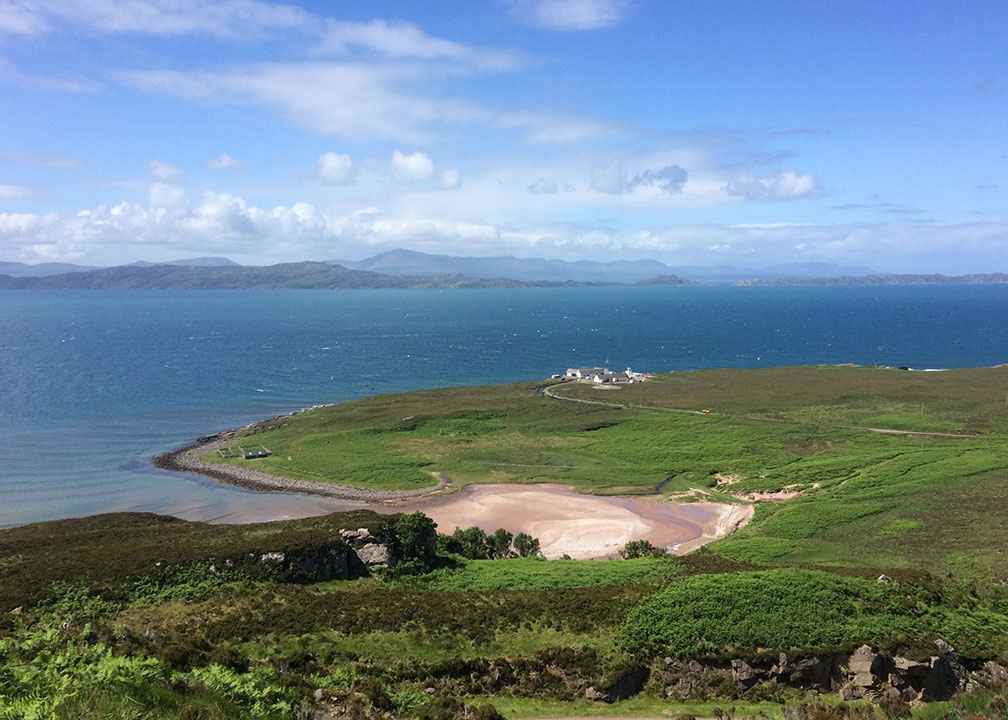
Torridon is the mountain country between Applecross and Gairloch. The hills here — Beinn Alligin, Liathach, Beinn Eighe — are among the oldest mountains in the world, 600 million-year-old Torridonian sandstone sitting on even older Lewisian gneiss. They rise straight out of Loch Torridon in dramatic tiered cliffs.
The village of Torridon is tiny. Shieldaig, a single row of whitewashed cottages along a sea loch, is prettier. The Shieldaig Bar is a good stop.
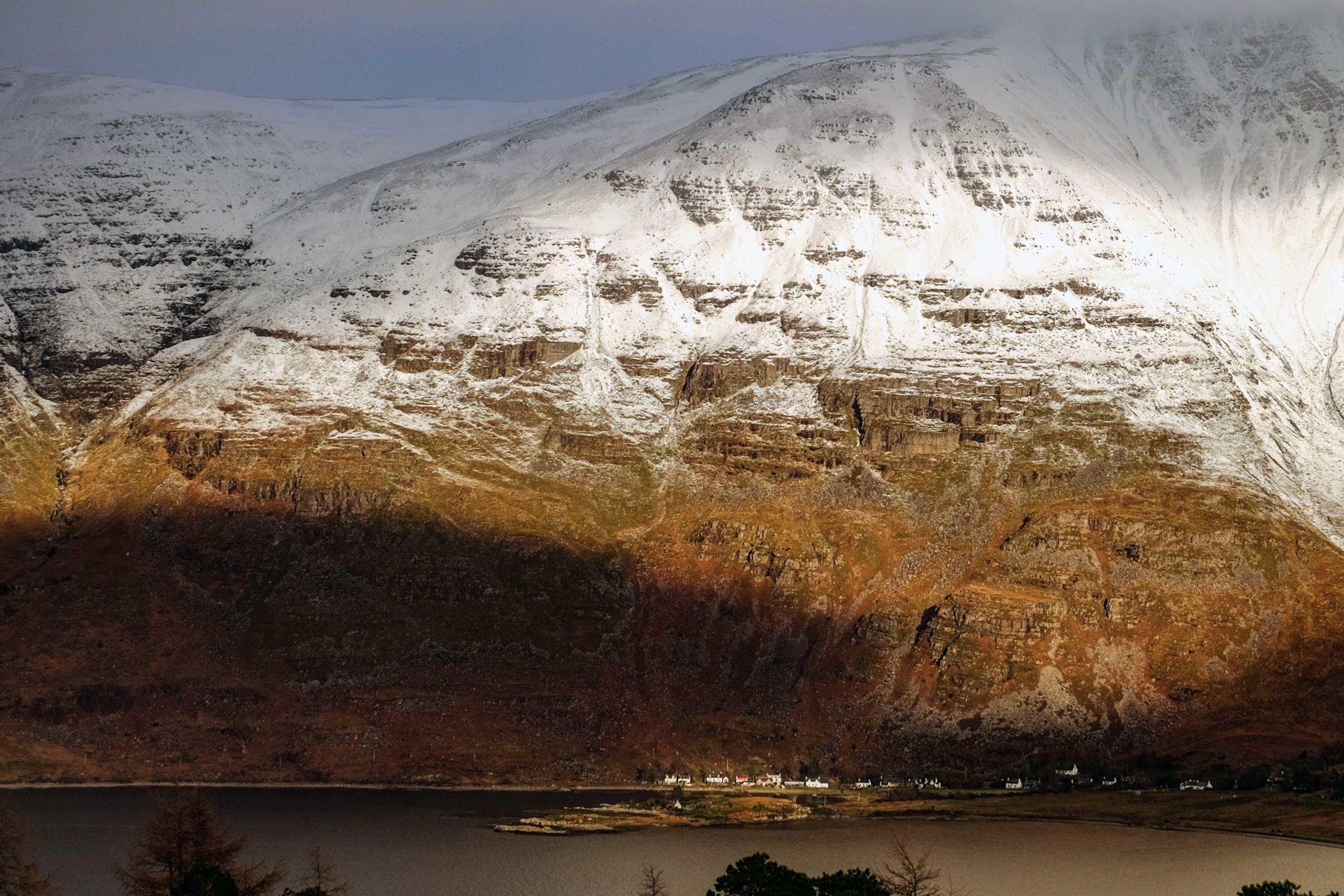
Gairloch and Poolewe
Gairloch is a scattered village on a wide bay, with wildlife tours from the harbour (dolphins, whales, basking sharks in summer), Red Point beach south of the village (red sand), and Big Sand beach north (views to Skye).
Inverewe Garden at Poolewe is one of Scotland’s most beautiful gardens, a subtropical garden on the same latitude as Siberia, made possible by the Gulf Stream. Inverewe House has recently been opened to the public.
Corrieshalloch Gorge, just east towards Ullapool, has the 150-foot Falls of Measach thundering through a 200-foot gorge crossed by a Victorian suspension bridge.
Stay at: the Gairloch Hotel or the Myrtle Bank Hotel, for self catering stay at Port House or Ach-Na-Clachan or Morlich.
Read more: my guide to Wester Ross.
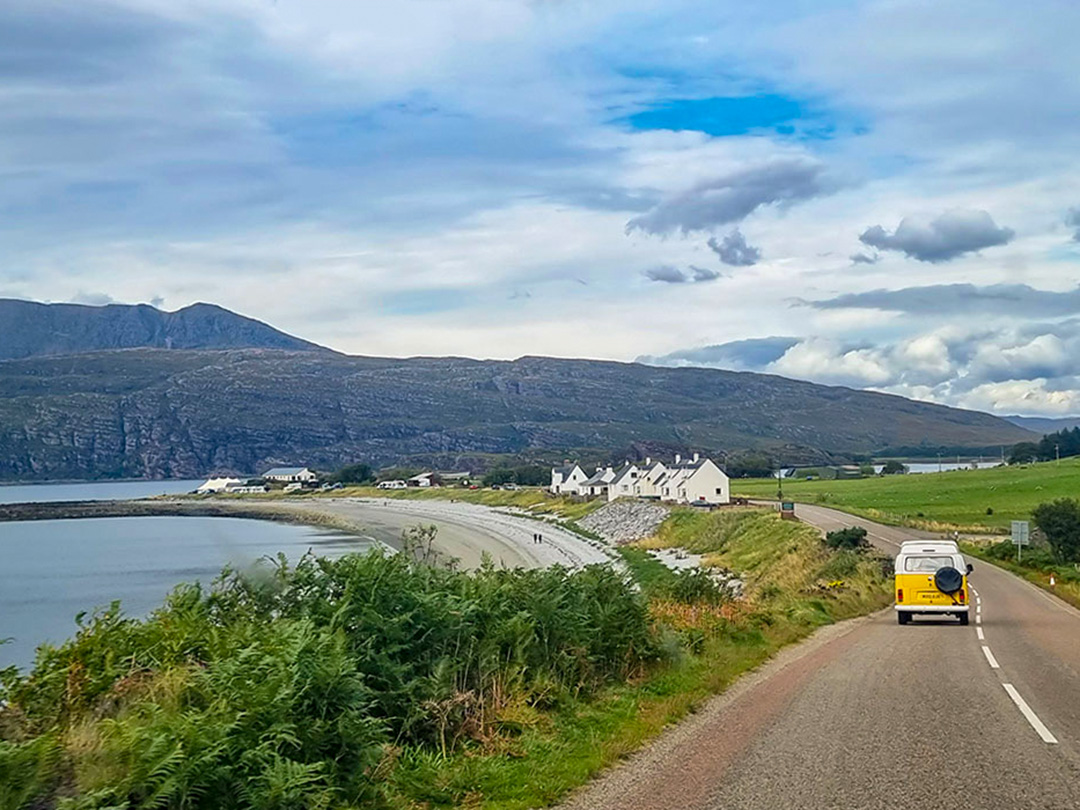
The North-West Highlands: Ullapool, Assynt and Cape Wrath
North of Wester Ross, the west coast becomes Assynt and eventually Cape Wrath, Scotland’s remote north-western corner. This is the wildest, quietest, most geologically strange part of the west coast. Mountains rising alone from flat moorland. Beaches that rival the Caribbean. Some of the darkest skies in Britain.
Ullapool
Ullapool on Loch Broom is the main town of the north-west. It’s a planned village from 1788, laid out by the British Fisheries Society. CalMac ferries leave from here to the Outer Hebrides (Stornoway).
The waterfront is lined with whitewashed buildings, good seafood restaurants and pubs. The Seafood Shack on the main street is a festival favourite and the Ceilidh Place hosts traditional music. At Rhue Lighthouse just outside town you can watch a west coast sunset over the Summer Isles.
Ullapool is also a good base for climbing Stac Pollaidh (a small mountain with an outsized reputation, 30 minutes up from a roadside car park) and Suilven, the iconic sugarloaf mountain of Assynt.
Stay at: Harbour House, The Royal Hotel, Clachan Garden B&B, for glamping try Highland Bothies, or stay at Ullapool Campsite. There is also a hostel in Ullapool. For luxury accommodation in Ullapool – check out the amazing Stone Houses. For self catering – Fisherman’s Cottage, Ullapool a cute 3 bed self-catering cottage or Harbour House.
Read more: my guide to Ullapool.
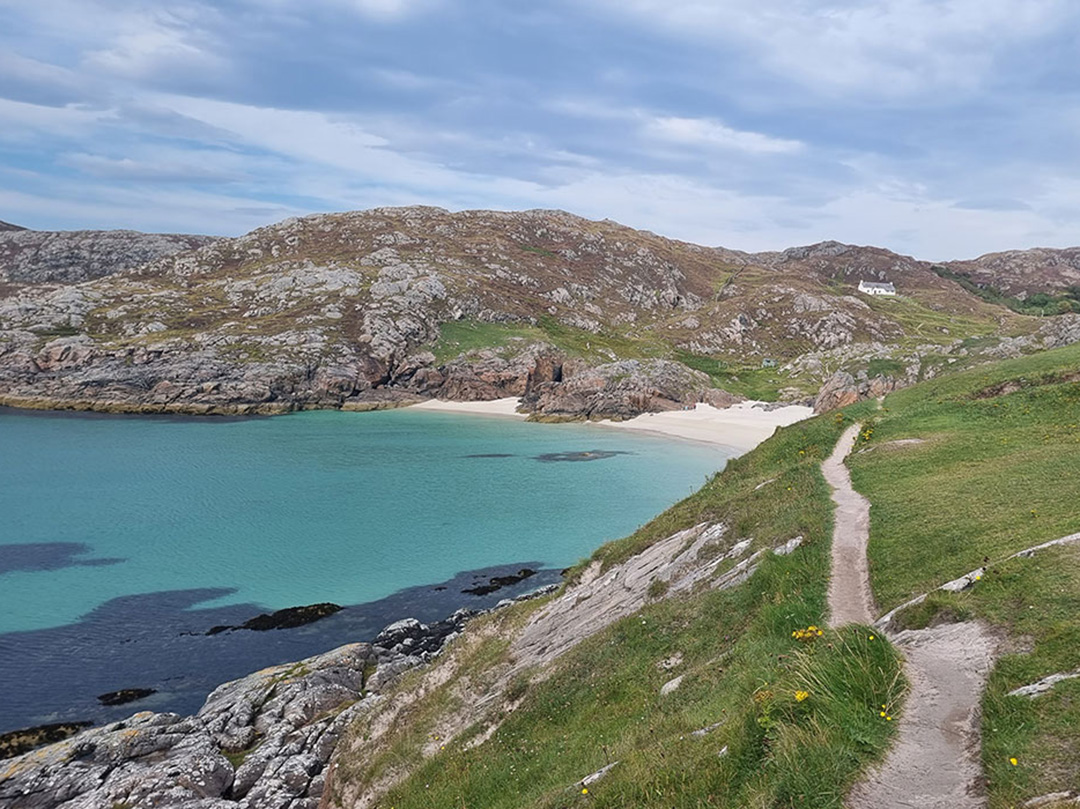
Assynt and Lochinver
Assynt’s landscape is otherworldly with hills rising abruptly from moor and loch, and the light changes by the minute. It’s a walker’s paradise, a photographer’s dream and home to some of the world’s best beaches at Achmelvich and Clachtoll – and one of my favourite places in the world.
The mountains – Suilven, Quinag, Canisp, Cul Mor, Stac Pollaidh – rise as individual peaks from the flat moors. There’s nothing quite like it anywhere else.
Lochinver is Assynt’s main village, a lively fishing port with a famous pie shop (Lochinver Larder), and views of Suilven from the harbour. Nearby beaches at Achmelvich and Clachtoll are world-class.
Knockan Crag south of Lochinver is the site of the 19th-century Highland Controversy, when geologists discovered younger rocks lying on top of older ones, leading to the theory of thrust faulting. The visitor centre explains it well.
Stay at Inver Lodge, the five-star hotel with views of Suilven, the two bed Kirkaig Lodge, Ardmore House B&B, Achmelvich View self catering or Coillessan Lodge.
Read more: my guide to Lochinver and Assynt.
Kylesku
Kylesku is a hamlet at the meeting of three sea lochs, with a dramatic curved bridge (the 1984 Kylesku Bridge) crossing the narrows. The Kylesku Hotel has a well-earned reputation for local seafood.
Once reliant on a free ferry service, the Kylesku Bridge was opened in 1984 – the bridge is a gorgeously curved structure loved for its design and setting. Take a boat trip to Eas a’ Chual Aluinn, the UK’s tallest waterfall with North West Sea Tours.
Hillwalkers head to the magnificent Quinag and the surrounding Assynt hills.
Stay at: the Kylesku Hotel known for its local seafood or the nearby Newton Lodge which offers fine dining for residents (review here!)
Read my guide to things to do at Kylesku.
Handa Island
Handa Island is a seabird reserve just off the coast north of Scourie. A passenger ferry runs in summer. The island has one of Britain’s largest colonies of guillemots, razorbills, kittiwakes, and skuas, and a small population of puffins. It’s a National Nature Reserve managed by the Scottish Wildlife Trust.
The Handa Island ferry departs from the tiny settlement of Tarbet, 10 minutes north of Scourie down a single track road. The ferry is a modern passenger RIB which takes up to 12 people at a time.
Stay at: there is no accomodation on the island, but you can stay nearby at The Croft, Handa Island Pod or Tighlochan Pods, or the well regarded Eddrachilles Hotel.
Read more: my guide to Handa Island.
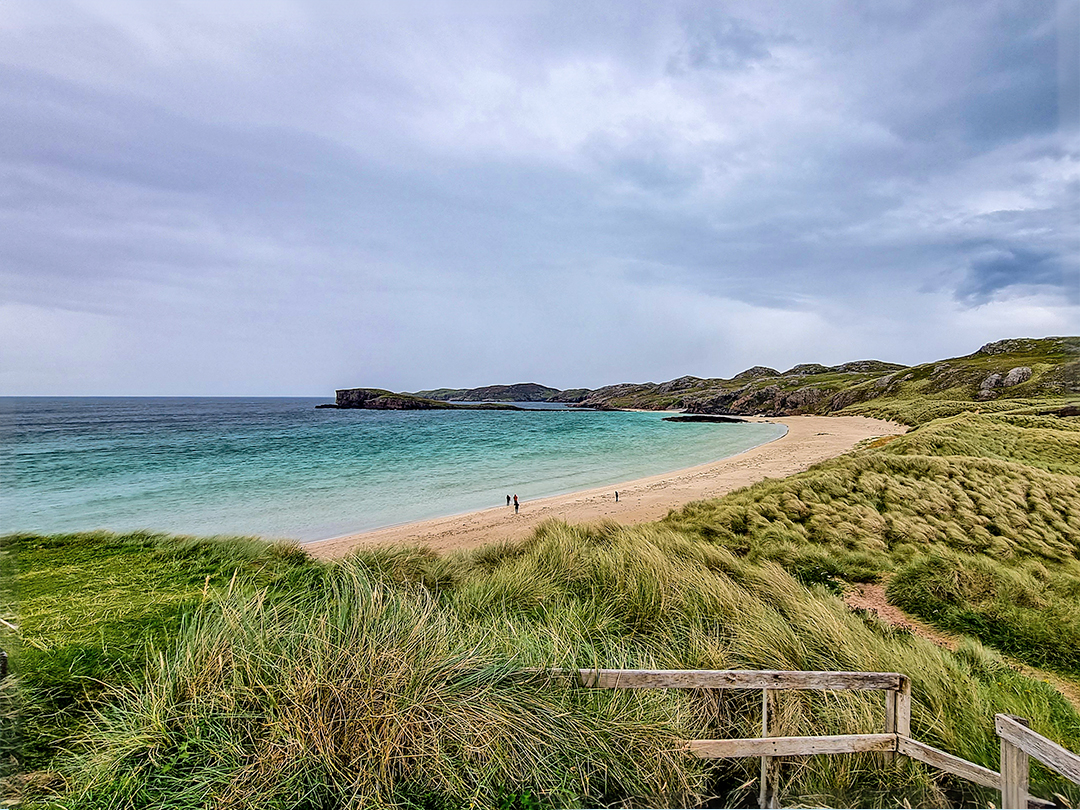
Oldshoremore, Sandwood Bay and Cape Wrath
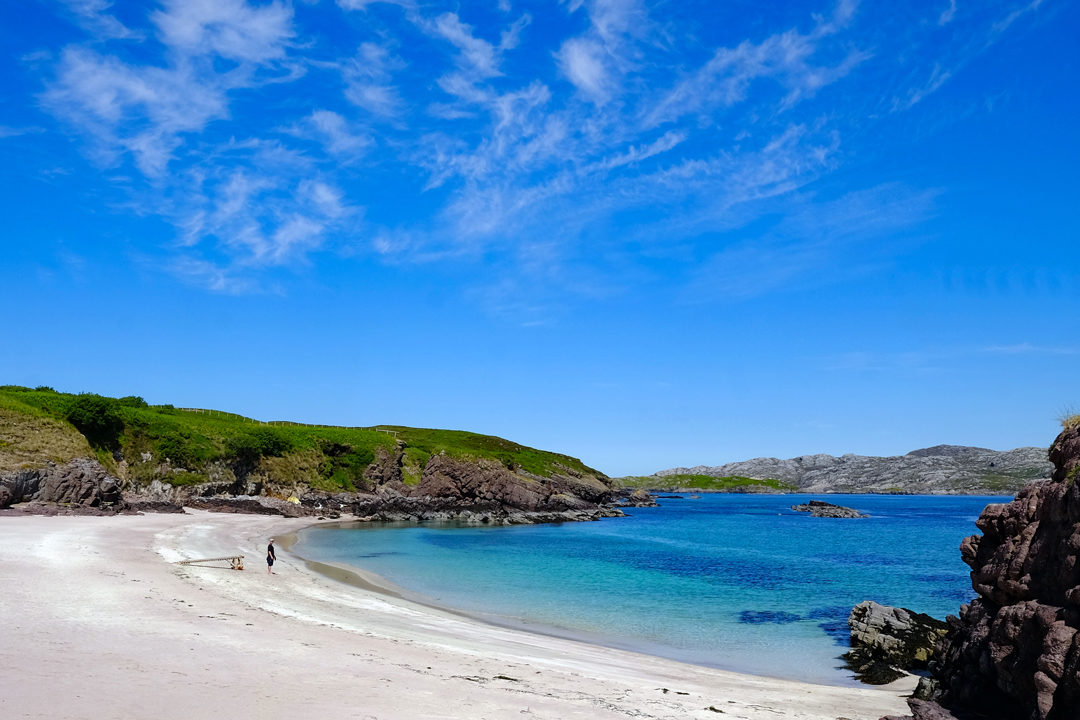
The road north of Scourie runs out at the tiny village of Kinlochbervie. From there, the road continues another few miles to the hamlet of Balchrick, with access to my favourite beach in Scotland: Oldshoremore. White sand, turquoise water, and barely another soul even in peak summer.
A long walk from Oldshoremore leads to Sandwood Bay, one of Scotland’s most iconic and remote beaches. It’s a four and a half mile trek across moorland, but the reward is spectacular: pink sand, sea stacks, and Atlantic waves.
Part of the Sandwood Estate owned by the John Muir Trust, the beach is a nature reserve and a Site of Special Scientific Interest due to its rich and beautiful machair habitat. The beach is accessible via a footpath from a nearby car park, which offers toilet facilities. A rocky peninsula, Eilean na h-Aiteig, separates it from neighbouring Polin Beach.
Cape Wrath, Scotland’s north-west corner, is even more remote. You reach it by minibus from the Kyle of Durness ferry, across an active military firing range. The lighthouse at the Cape has been marking the corner of Britain since 1828.
Stay at: Oldshoremore Croft Cabins, this lovely eco cabin, stay on a croft at the dog friendly Aisir Croft Cottage. Or stay at the family friendly Munro House or Beach View.
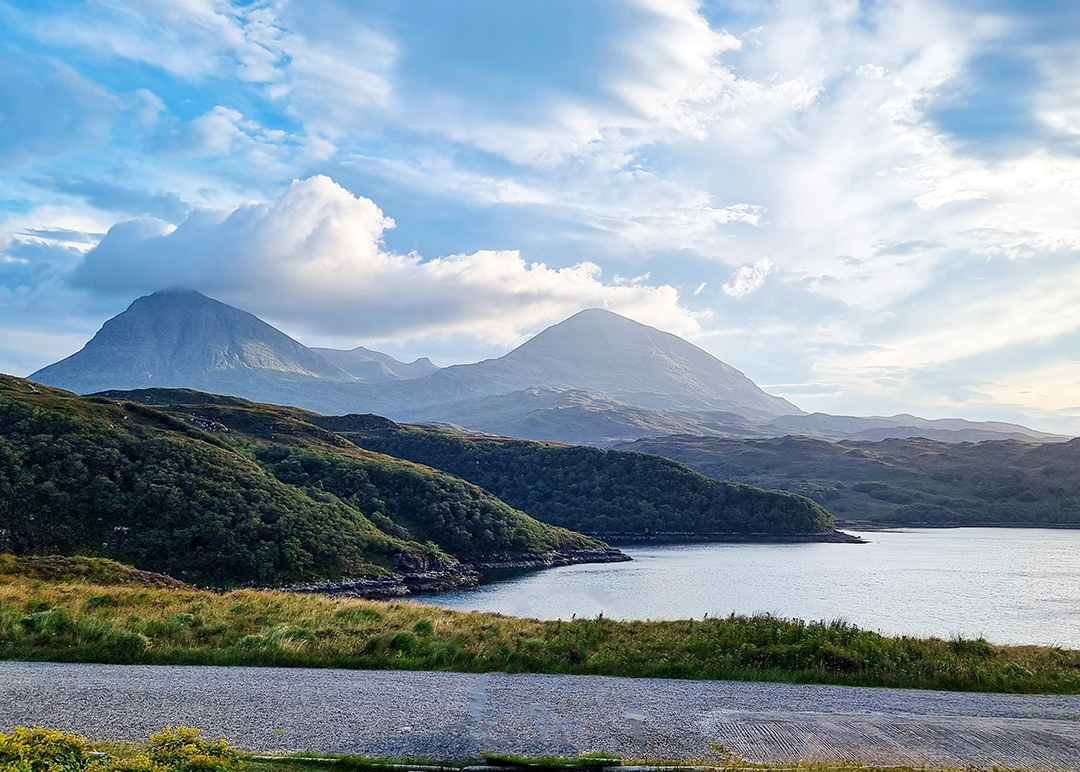
Suggested itinerary: an 8-day west coast road trip
If you want a great road trip route rather than a region-by-region pick-and-choose, here’s the 8-day ferry-hopping route I’d recommend for a first west coast trip. It covers Argyll, Mull, Ardnamurchan and Skye, with a CalMac HOP7 ticket covering the three ferry crossings.
- Day 1 – Glasgow to Inveraray. Loch Lomond (lunch at Luss), Rest and Be Thankful pass, Inveraray for the night.
- Day 2 – Inveraray to Oban via Crinan and Kilmartin Glen.
- Day 3–4 – Oban to Mull. Ferry from Oban to Craignure (55 minutes). Base in Tobermory. Day trip to Calgary Bay or a boat trip to Iona and Staffa.
- Day 5 – Mull to Ardnamurchan. Ferry from Tobermory to Kilchoan (40 minutes). Explore Sanna, Ardnamurchan Point lighthouse, Castle Tioram.
- Day 6–8 – Ardnamurchan to Skye via Mallaig. Travel from Arnamurchan to Mallaig to catch the ferry to Armadale (30 minutes). Three days on Skye – Sleat on day one, the Cuillin and Fairy Pools on day two, the Trotternish loop (Old Man of Storr, Quiraing) on day three.
To extend the trip, continue north from Skye via the Skye Bridge to Plockton, then up the coast to join the North Coast 500. Or continue south back to Oban.
Practical information
When to visit the west coast
May, June and September are best. Long days, reasonable weather, fewer midges than July and August (when midges on the west coast can be serious). Winter is dramatic but daylight is very short (sunset at 3.30pm in December), many businesses close, and single-track roads can be dangerous in snow. April and October are quieter but unpredictable.
How long to spend
A long weekend covers one region. A week covers two adjacent regions. Two weeks lets you drive the full length of the west coast with time for ferries.
How to get around
A car is essential. Public transport is limited, particularly north of Ullapool. Hire cars can be picked up at Glasgow, Edinburgh or Inverness airports. Campervans are popular but not always welcome on single-track roads.
Ferries are run by Caledonian MacBrayne (CalMac). Book in advance for summer.
Driving on single-track roads
Most west coast roads north of Fort William are single-track with passing places. The rules: pass on the left, use passing places to let faster traffic overtake, never park in passing places, and expect to meet sheep around every bend. Drive at a pace that lets you stop in the distance you can see.
Where to stay
Book well in advance for summer, especially on Skye, Mull, and in the popular villages like Plockton and Lochinver. Shoulder-season (May, September) is much easier. Out of the main villages, self-catering cottages often offer better value than hotels.
Frequently asked questions
What's the best part of the west coast of Scotland?
It depends what you want. For dramatic mountains, Torridon and Assynt. For beaches, the Silver Sands of Morar and Oldshoremore. For pretty villages, Plockton and Tobermory. For remote wilderness, Knoydart and Cape Wrath. For a first visit, Glencoe plus Ardnamurchan or Oban plus Mull are hard to beat.
How many days do you need to explore the west coast of Scotland?
A minimum of four days for one region. A week lets you combine two regions. Two weeks covers the full coast from Glasgow to Cape Wrath with time for islands.
Is the North Coast 500 the same as the west coast of Scotland?
No. The North Coast 500 is a 500-mile driving route starting and ending in Inverness that loops around the northern Highlands. It covers part of the west coast (roughly Applecross to Durness) but misses most of it — no Glencoe, no Argyll, no Mull, no Ardnamurchan. The west coast of Scotland is a much bigger area than the NC500.
What's the best beach on the west coast of Scotland?
Oldshoremore, near Kinlochbervie — white sand, turquoise water, rarely busy. Other contenders: Sandwood Bay (remote, walk-in only), Sanna on Ardnamurchan, Camusdarach on the Silver Sands of Morar, Achmelvich in Assynt, and Calgary Bay on Mull.
Are ferries to the Scottish islands expensive?
No. CalMac ferries are relatively affordable compared to other European ferry networks. A foot passenger return to Mull is under £10. A car return is around £50–60. The Hopscotch multi-ferry tickets offer discounts for common routes.
Can you drive the whole west coast of Scotland in one trip?
Yes, but it takes at least 10–14 days to do properly. The driving distance from Glasgow to Cape Wrath is about 400 miles, but single-track roads mean slow progress and plenty of places worth stopping for.
What's the weather like on the west coast of Scotland?
Wet. The west coast gets the brunt of Atlantic weather and rainfall is high, especially around Fort William and the western Highlands. Pack waterproofs year-round. On the plus side, the Gulf Stream means the west coast is milder than the east — palm trees grow in Plockton, Gigha and Logan Garden.
More Scotland road trip reading
- The North Coast 500: Scotland’s most famous road trip
- The South West Coastal 300
- The North East 250
- How to plan a Scotland road trip
- Scottish island hopping guide
Kate — Love from Scotland x