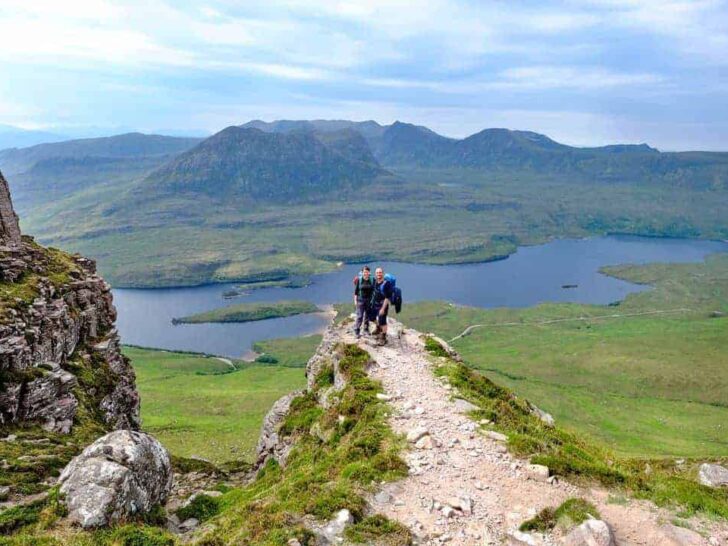


Assynt and Lochinver sit in the far north-west of Scotland, roughly 5 hours’ drive north of Glasgow or 2 hours from Inverness.
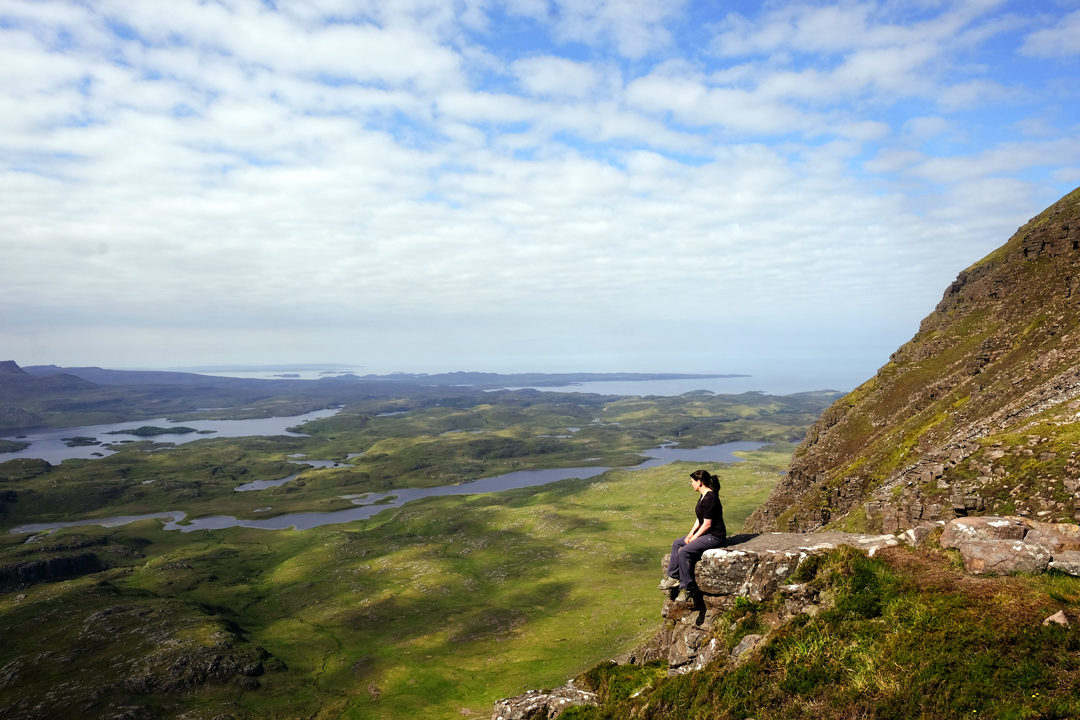
It’s one of the emptiest, most dramatic corners of the country, with otherworldly mountains like Suilven and Stac Pollaidh rising straight out of lochan-pocked moor, Caribbean-turquoise beaches at Achmelvich and Clachtoll, puffins on Handa Island, and the legendary pies at Lochinver Larder that people genuinely drive two hours to eat.
It’s officially a detour off the North Coast 500, between Ullapool and Unapool, but a detour that absolutely earns its diversion. This is my full guide to visiting – here’s what not to miss, where to eat, and how to get here.
Things to do in Lochinver and Assynt
Visit Scotland’s best beaches (probably)
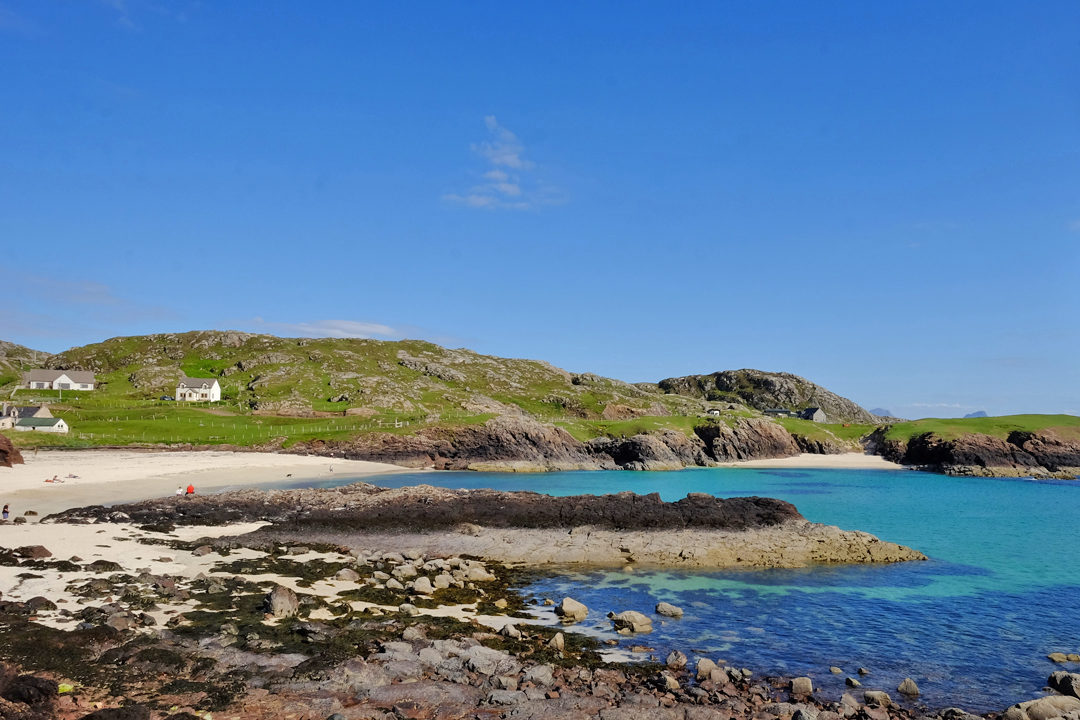
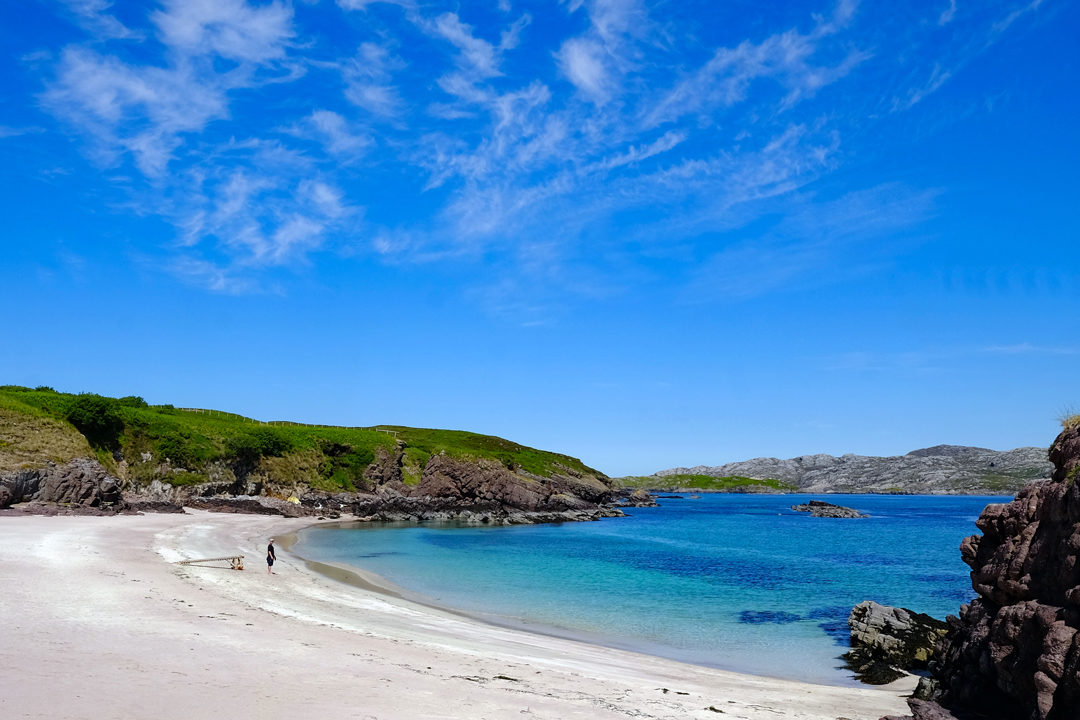
All the beaches near Lochinver would make the UK’s top ten – with turquoise waters, black rocks and white sands you could be in the Caribbean, not Scotland. However, this is Scotland!
Achmelvich is one of Scotland’s most famous beaches, and with clear blue water, a nearby caravan park and youth hostel, and an incredible view of Suilven.
Achmelvich Beach is around 15 minutes north of Lochinver off the B869 along the single track (and at times slightly hairy) Drumbeg Loop. You can also walk to Achmelvich from Lochinver.
My favourite of the beaches near Lochinver is Clachtoll which is about 30 minutes further west round the loop where there is another campsite and a broch out on the headland, one of my favourite Iron Age Brochs in Scotland.
Lochinver’s beaches are also great for wild swimming – if you can cope with the temperature of the North Atlantic Ocean that is!
Catch the ferry to Handa Island
Whilst not technically in Assynt, Handa Island Wildlife Reserve is worth a visit for the views back over the Lochinver region alone. Despite being protected by all manner of wildlife acronyms (Handa is a SSSI and SPA) you can visit the island by crossing the Sound of Handa by RIB from the tiny hamlet of Tarbet.
You will be met off the little ferry for an island introduction by a Scottish Wildlife Trust volunteer before you wander off on your own Handa Island tour.
Stroll along the island’s boardwalks, spot the different varieties in the 100,000 seabirds including puffins, kittiwakes and eagles soaring over the sea stacks.
It will take you around 2 hours to walk around the island’s 4-mile circular boardwalk path, longer if you stop every few seconds to scan the cliffs for puffins. Or just sit and watch the changing light over Suilven and Cul Mor. Handa is a tiny island paradise.
A visit to Handa Islandis £15 per adult. Catch the tiny ferry to Handa from Tarbert near Scourie.
Solve the long-running argument at Knockan Crag
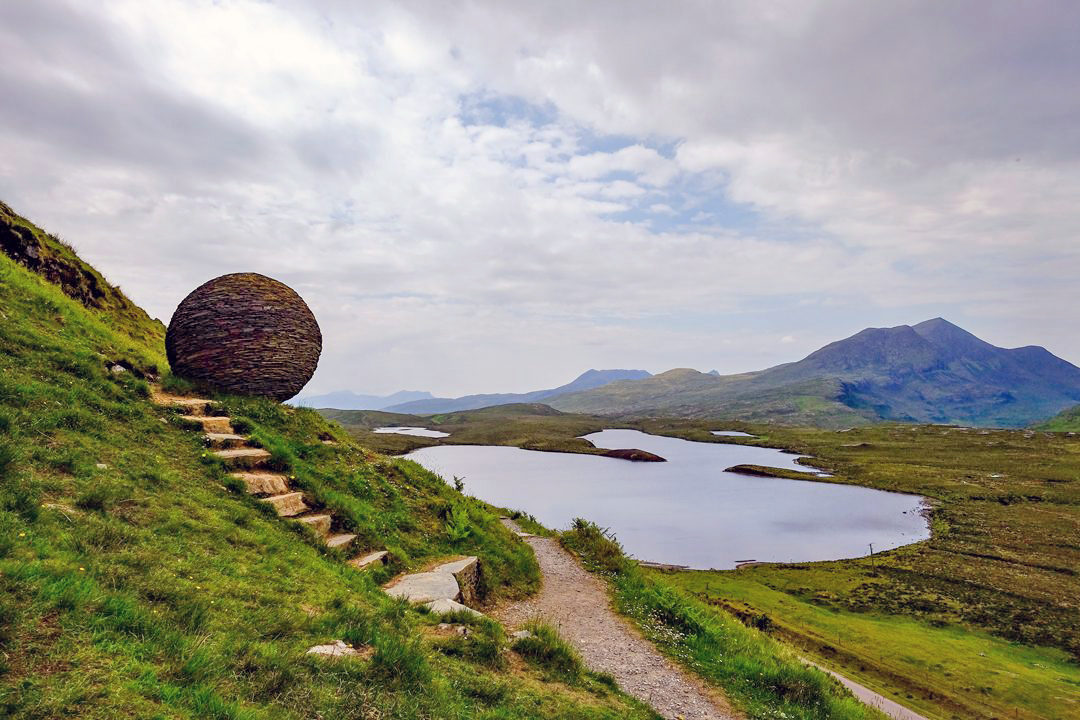
Knockan Crag accidentally rewrote how we understand the planet, and it’s worth a visit even if rocks aren’t normally your thing.
Visit this modest-looking cliff about 30 minutes south of Lochinver on the road to Ullapool and you’ll find something odd: the rock at the top is older than the rock at the bottom. Which should be impossible.
In the 1860s this sparked the Highlands Controversy, one of the most bitter arguments in the history of British science. The establishment insisted the rocks must be the same age, just tilted. A handful of upstart geologists spent decades proving that the older rock had been pushed, physically shoved, dozens of miles westwards over the younger rock by an ancient continental collision. They called this enormous crack the Moine Thrust, and when they were finally proved right in the 1880s it effectively invented modern structural geology.
The site has an excellent free visitor centre, interpretation boards that actually manage to make the geology engaging, and a walking trail with one of the best short views in Assynt. The whole site is part of the North West Highlands UNESCO Global Geopark and run by NatureScot. Allow an hour at minimum.
Climb Stac Pollaidh
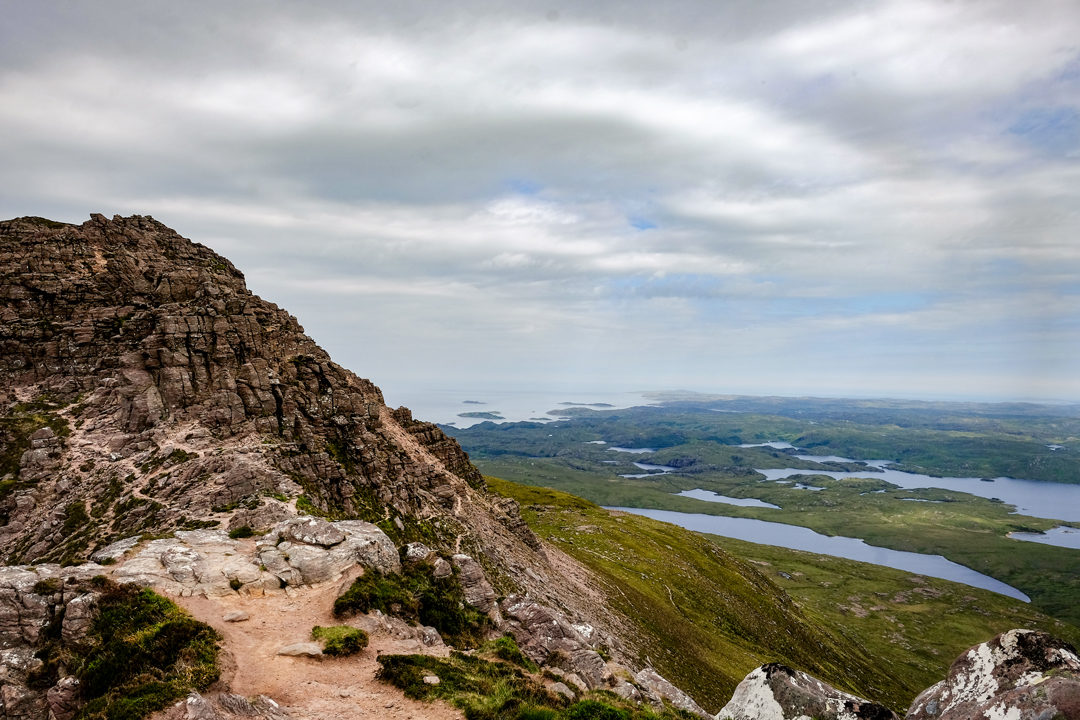
Despite rising to just under 2000ft, Stac Pollaidh (pronounced Stac Polly) is one of Scotland’s best short hill walks.
With a well-made path to the summit, easy and fun scrambling over its pinnacles and ridges and incredible views of the mountains of the Inverpolly Nature Reserve, down to Loch Lurgainn and across to the mighty Cul More and Suilven, this mini-mountain punches well above its weight.
Along with some great scrambling at the top – you get a big pay off for such a short climb. Climbing Stac Pollaidh is not to be missed. Park at the car park at Loch Lurgainn.
Get there early, this is a popular hill walk and the car park gets full quickly. Do not park in passing places.
Read more: How to climb Stac Pollaidh
Eat a Lochinver Pie
Lochinver is well known as a foodie destination, with the pies sold at Lochinver Larder on the village’s main street spoken about in hushed tones across Scotland.
From traditional steak, haggis, and venison, to cauliflower cheese, the pies are stuffed full of filling and well worth the eye-watering price tag. Best served up with a side of beans and a great view, my favourite is the chicken curry.
You can also order Lochinver Pies by Post
Drive over the Kylesku Bridge
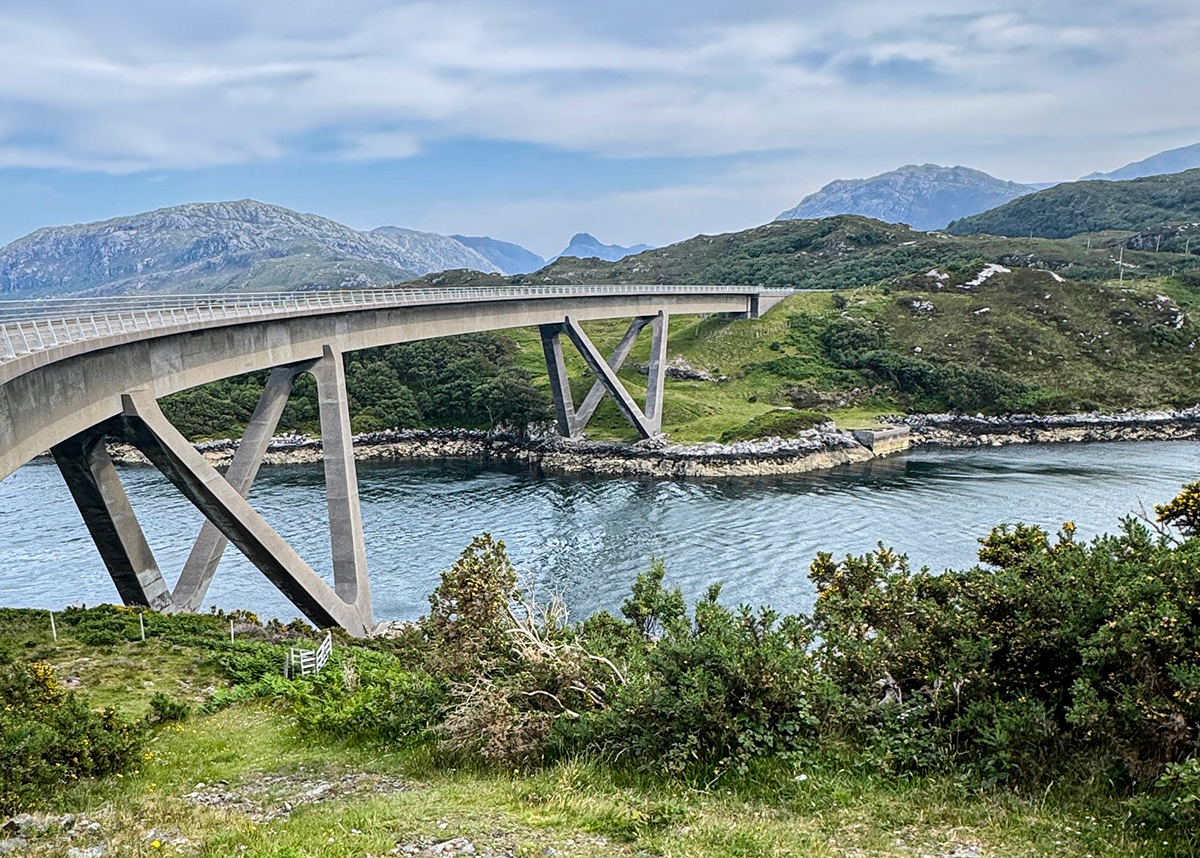
Opening in 1984 the much photographed Kylesku Bridge replace a tiny ferry between the hamlet of Kylesku and Kylestrome – the bridge is now one of the icons of the NC500. Don’t forget to visit Kylesku Bridge is on the NC500 (A894) 30 minutes north of Lochinver.
Read more – why you should visit the Kylesku Bridge
Visit Ardvreck Castle
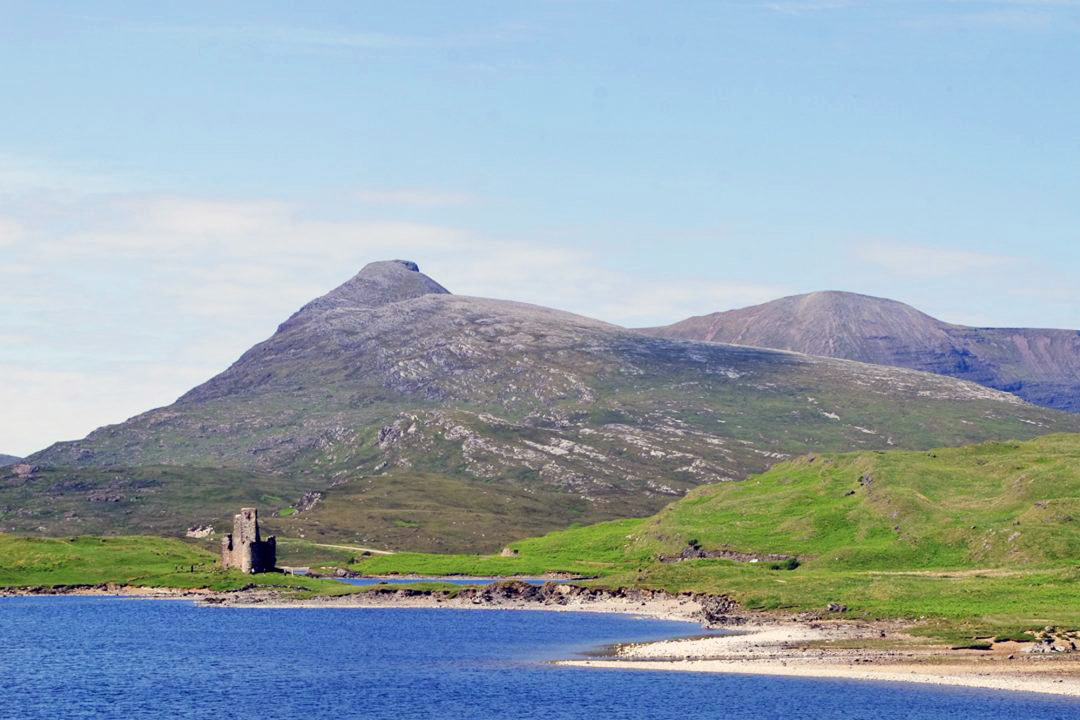
Sitting on the banks of Loch Assynt sits the ruins of Ardvreck Castle, once a 15th-century stronghold of Clan MacLeod, longtime owners of the Isle of Skye and the Isle of Lewis and Harris.
Besieged by the MacKenzies of nearby Wester Ross in 1672 it was then abandoned and used to build the clan a new opulent residence – the nearby Calda House – which was said to have been built with views of the castle to celebrate the MacLeod’s downfall…
Ardvreck Castle is 20 minutes east of Lochinver and on the North Coast 500.
Explore the paths around Lochinver
- Hike out to the Old Man of Stoer a spectacular sea stack off the coast of Assynt.
- 10 miles north of Lochinver is Clashnessie Bay with its pretty beach. Walk from the beach to Clashnessie Falls, a 15m high waterfall.
- For a low level, family friendly stroll visit the Culag Woods on the edge of the village.
Mountain climb in the Inverpollaidh Nature Reserve
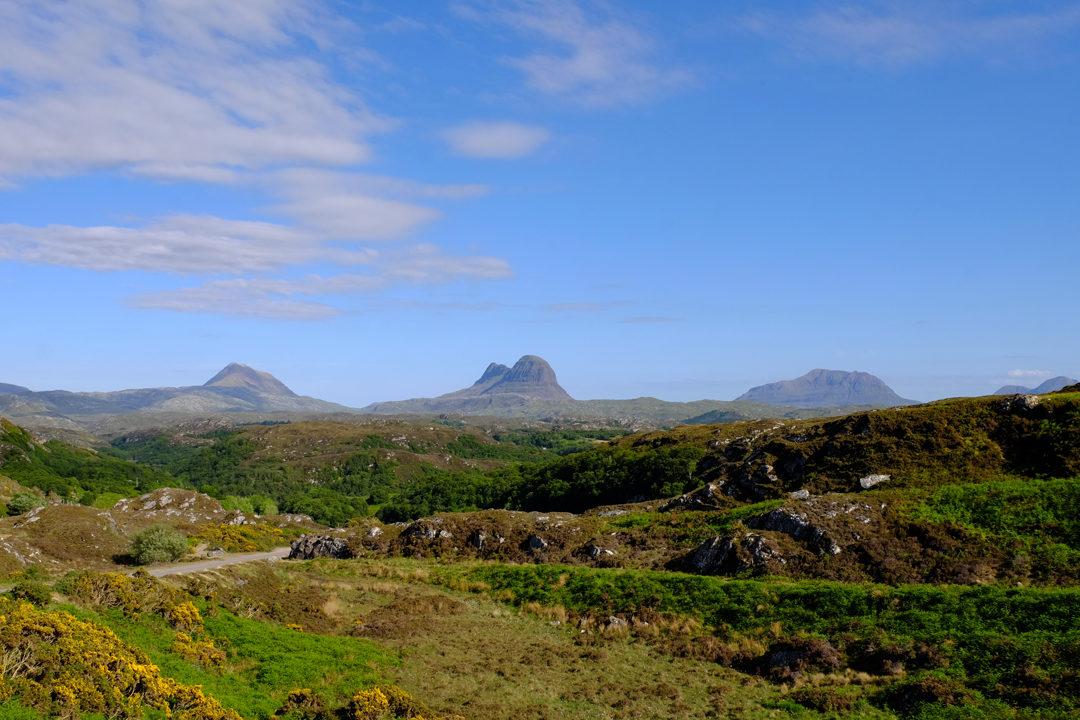
Much of Assynt is covered by hundreds of lochs, bogs and moorland making up the Inverpolly Nature Reserve. Hill baggers will want to climb Scotland’s most dramatic mountains – Suilven, Cul More, Quinaig and the two Munros – Ben More Assynt & Conival or if you aren’t feeling quite so energetic walk up to the Kirkaig Falls.
The Inverpolly Nature Reserve is just east of Lochinver and accessible by foot from the village.
How to get to Lochinver & Assynt
If you aren’t driving the NC500, Lochinver is around 5 hours north of Glasgow and Edinburgh and 2 hours from Inverness.
Whilst the best way to explore Assynt is by car – there are daily bus services.
To get to Lochinver catch the Far North Bus service 804 from either Durness or Ullapool.
Best time to visit Assynt & Lochinver
Assynt is beautiful all year, but it’s a very different place depending on when you come.
- May to early June – If I could pick time of year to visit Assynt, this is it. Long daylight (18+ hours by mid-June), the weather’s about as stable as Scotland gets, the mountains haven’t disappeared into cloud yet, and crucially the midges haven’t really started.
- July and August – The busiest months, the warmest temperatures, and also when the midges are at their worst. Fine if you book early and don’t mind sharing Achmelvich beach with other humans, but not the quiet solitude Assynt is famous for. Read my midge survival guide before you come.
- September and October – My second favourite time. The midges are gone by the end of September, the crowds thin right out after the August bank holiday, the heather is still purple into early September, and October brings the bracken turning orange and the first snow on the tops. Bring warmer layers and expect shorter days.
- November to March – Only for the dedicated, empty beaches have to be weighed up against short days and closed cafés – but you might see the the northern lights if you’re lucky.
Where to stay in Assynt and Lochinver
Assynt isn’t the place to turn up and hope. Book ahead, especially in summer.
Self-catering cabins and cottages
A cabin with a view of Suilven beats any hotel room, and Assynt has some of the best self-catering in Scotland. The Batbox sits high on a hillside above Loch Kirkaig, ten minutes from Lochinver, one of my favourite cabins anywhere in Scotland, and walking distance from Lochinver Larder if you time it right. Beyond that, check into the Mountain View Pod (with hot tub), The Ardmore Shepherd’s Hut, or Suilven View.
Hotels and inns
Lochinver and Assynt have a few scattered hotels, the Inver Lodge Hotel above Lochinver, the Kylesku Hotel up by the bridge, and Eddrachilles Hotel.
Campsites
There are two standout campsites in Assynt, both located on the beach. Shore Caravan Site at Achmelvich is right on the sand, wake up to turquoise water and the view of Suilven on a clear morning, which is reason enough. Clachtoll Beach Campsite is 30 minutes further round the Drumbeg Loop and quieter, with the same white sand and a shop on site.
Hostels
The Achmelvich Beach Youth Hostel (Hostelling Scotland) is one of the loveliest cheap stays in Scotland if you don’t mind basic, bunks in a low stone building literally on the dunes.. There’s also an independent bunkhouse at Inchnadamph Lodge, good for walkers and climbers.
Wild camping
Assynt is classic wild camping country, the Scottish Outdoor Access Code applies, so you can pitch almost anywhere as long as you’re sensible, leave no trace and lightweight camp . If you plan to bring the kitchen sink with you, wild camping is not for you. The usual rules: don’t camp in enclosed fields, avoid making a fire on peat ground, and take back your rubbish. You’ll have to plan your visit carefully around the midges.
Where to eat in Lochinver and Assynt
Lochinver Larder
The obvious one, and deservedly. Pies with fillings from classic steak and venison through to chicken curry (my pick) and cauliflower cheese. Eat in with beans and a view, or take a cold one home and reheat it badly in a cabin oven. If you can’t make it up, Pies by Post will deliver a box anywhere in the UK.
Peet’s Restaurant
Peet’s sits on the harbourside and has quietly become the village’s most-booked restaurant, consistently rated number one in Lochinver, known for fresh seafood including a daily delivery of creel-caught langoustines, local scallops and seafood platters. It’s closed on Wednesdays and gets booked up days in advance in summer, so plan ahead.
An Cala Café
Over by the Lochinver Mission on Culag Park, An Cala is a family-run café-cum-bunkhouse doing home-cooked breakfasts, lunches and early-evening meals. The specials board leans heavily on seafood landed a few hundred yards away, and there’s no corkage if you bring your own bottle. Opening hours shift with the season and it’s closed on Sundays, call ahead if you’re making a special trip.
Further afield
If you’re staying longer or willing to drive, the Kylesku Hotel does good food over looking the loch beside the Kylesku Bridge.
Frequently Asked Questions
Where is Assynt and Lochinver?
Assynt and Lochinver are in the far northwest of Scotland, in Sutherland. Lochinver is around 5 hours north of Glasgow and Edinburgh, and approximately 2 hours from Inverness. The area is part of the North Coast 500 route, between Ullapool and Unapool.
What is Assynt famous for?
Assynt is famous for its otherworldly mountain landscapes — Suilven, Stac Pollaidh, Cul Mor and Quinag are among the most dramatic and distinctive peaks in Scotland. It is also known for its beautiful white sand beaches at Achmelvich and Clachtoll, excellent wildlife including puffins on Handa Island, the ruins of Ardvreck Castle, and the legendary pies at Lochinver Larder.
What are the best beaches near Lochinver?
Achmelvich and Clachtoll are the two standout beaches near Lochinver, both with turquoise water, white sand and black rocks. Achmelvich is around 15 minutes north of Lochinver off the B869. Clachtoll is a further 30 minutes west along the Drumbeg Loop and also has a nearby campsite. Both are excellent for wild swimming if you can handle the North Atlantic temperature.
Is Lochinver on the North Coast 500?
Lochinver is just off the main North Coast 500 route — you need to detour between Unapool and Ullapool to visit it, but it is absolutely worth doing. Kylesku Bridge and Ardvreck Castle, both on the NC500, are within 20–30 minutes of Lochinver.
What are the Lochinver pies?
The Lochinver Larder on the village’s main street sells handmade pies that have become legendary across Scotland. Flavours include steak, haggis, venison and cauliflower cheese, all generously filled. You can also order Lochinver pies by post via piesbypost.co.uk.
How do you get to Lochinver without a car?
There is a daily bus service — the Far North Bus service 804 — running to Lochinver from either Durness or Ullapool. However a car is by far the best way to explore Assynt properly, as many of the best beaches, hills and attractions are on single track roads well off any bus route.
Love, from Scotland x
Read more: How to drive the North Coast 500, more: things to do in Ullapool and how to visit Wester Ross


Leave a Reply