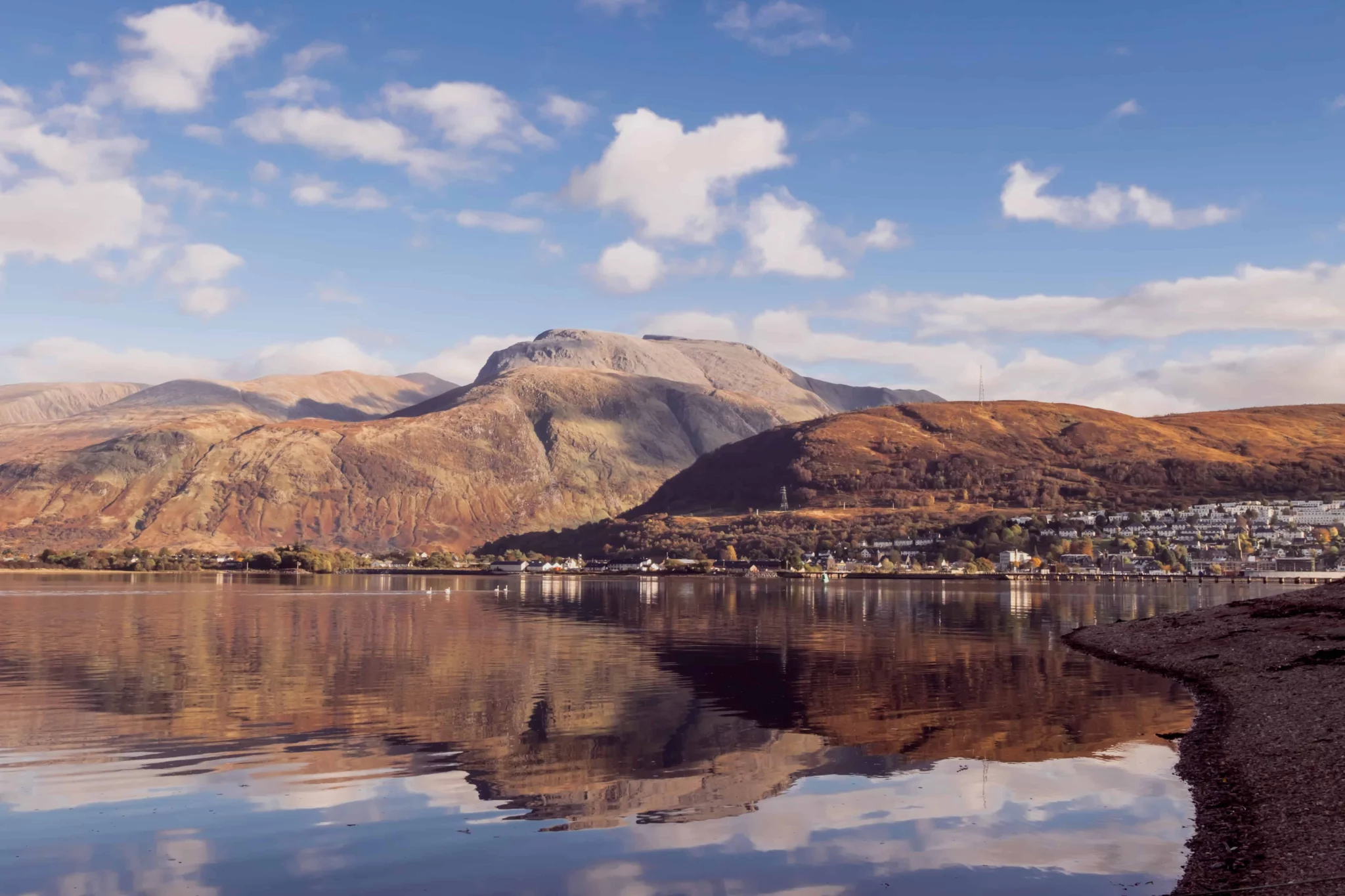


Ben Nevis is the UK’s highest mountain at 1,345 metres (4,413ft), rising above Fort William in the Scottish Highlands. Most people climb it by the Mountain Path from the Glen Nevis Visitor Centre, a 17.7km (11-mile) round trip that takes 7 to 9 hours.
I’m not a mountaineer or extreme adventurer. I’m a regular hillwalker who once thought Ben Nevis was well beyond me. When I climbed it, I struggled on the zigzags and hit thick fog near the top, so this guide covers exactly what I wish I’d known: how long it takes, how hard it really is, where to park, when to go and when not to.
Climbing Ben Nevis at a glance
| At a glance | Mountain Path (the standard route) |
|---|---|
| Height | 1,345 metres (4,413ft), the highest point in the UK |
| Distance | 17.7km (11 miles) round trip |
| Total ascent | 1,345 metres |
| Time | 7–9 hours for most walkers (about 4 hours up, 3 hours down) |
| Difficulty | Moderate to strenuous: no scrambling, but long, steep and rocky |
| Start | Glen Nevis Visitor Centre, 1.5 miles from Fort William town centre |
| Parking | Glen Nevis Visitor Centre (charge applies, fills by 8am on summer weekends), a small free car park near the Ben Nevis Inn at Achintee, or the Braveheart car park |
| Without a car | Train to Fort William, then the seasonal Glen Nevis bus (May–September) or a 10-minute taxi |
| Toilets | At the Visitor Centre only. There are none on the mountain |
| Best months | May to September. October to April is a winter mountaineering route |
| Weather warning | The summit is usually in cloud, can be 15–20°C colder than the glen, and can hold snow from September to July |
| Map | OS Landranger 41 / Explorer 392 |
The Mountain Path is suitable for fit beginners, but it is not an easy walk. The weather changes fast, navigation near the summit is difficult in fog, and proper clothing and preparation are essential.
Jump to section
Where is Ben Nevis?
Ben Nevis is in Lochaber in the Scottish Highlands, about four miles east of Fort William. It sits at the western end of the Grampian Mountains and, at 1,345 metres, is higher than anything in England or Wales. The walk starts in Glen Nevis, about 1.5 miles from Fort William town centre.
Fort William has good rail and road links from Glasgow and Inverness. Most people stay in the town or in Glen Nevis itself the night before so they can start early.
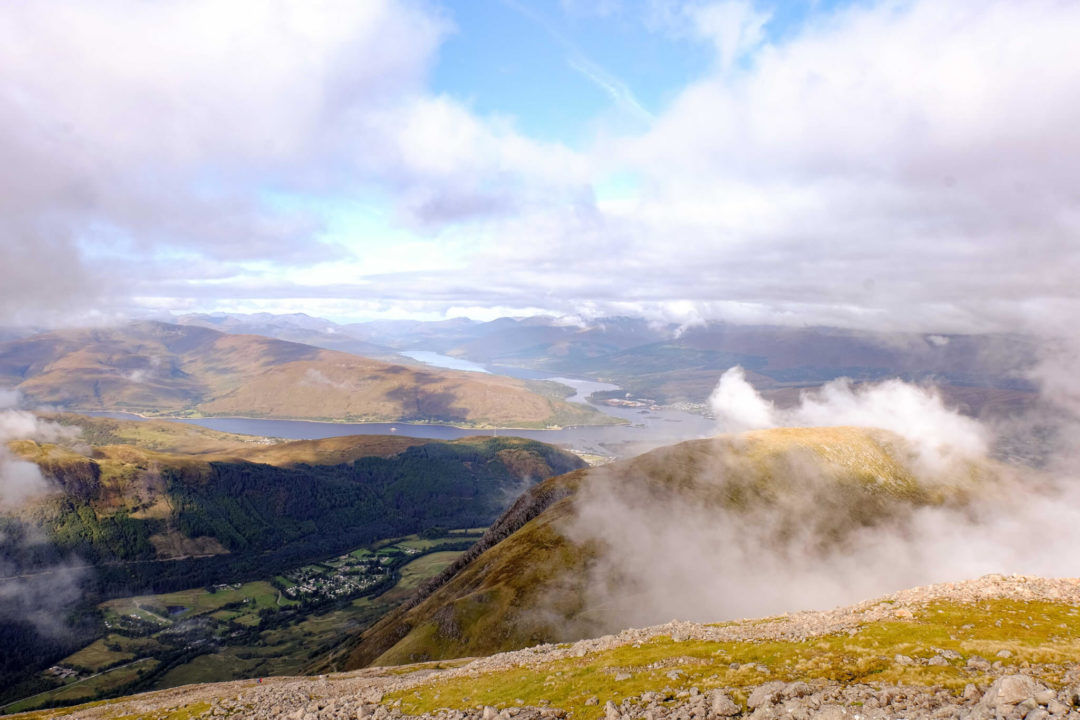
How to get to Ben Nevis
By car: Drive into Glen Nevis from Fort William. It’s well signposted, and the Glen Nevis Visitor Centre is your destination.
By bus: A seasonal bus runs between Fort William town centre and Glen Nevis from May to September (route 42). Check the current timetable before you travel.
By taxi: A taxi from Fort William costs around £10 each way and takes about 10 minutes.
By train: Fort William has a direct rail link from Glasgow Queen Street, taking around 3.5 hours.
Where to park for Ben Nevis
There are three main parking options:
- Glen Nevis Visitor Centre – the most popular and most convenient, with around 80 spaces. A charge applies (around £8 a day, but check on arrival as prices change). There are toilets and an information centre. It’s first come, first served, so consider taking the bus from Fort William.
- Ben Nevis Inn / Achintee – the Inn’s own car park is strictly for customers, but there’s a smaller free car park nearby. It’s slightly further from the official start of the Mountain Path, but perfectly placed for the pub at the end of the day.
- Braveheart car park – at the entrance to the glen, further from the start of the walk. £3 for the day.
The Glen Nevis Youth Hostel also has a car park with limited spaces if you’re staying there.
Tip: Arrive well before 8am on summer weekends. The Visitor Centre car park fills quickly, especially during school holidays and organised events.
The Visitor Centre and toilets are open from around 8am to 4pm from spring to late autumn. These are the last toilets you’ll see until you get back. There are no facilities on the mountain.
The Ben Nevis Mountain Path, step by step
The Mountain Path (also called the Pony Track, Tourist Route or Ben Path) is the standard route for first-timers. It’s the safest, most straightforward and busiest way to the summit. Don’t be misled by the “Tourist Route” name: this is still a serious, strenuous walk.
Stage 1: Visitor Centre to the Halfway Lochan (0–5km, 1.5–2 hours)
From the Visitor Centre, cross the bridge over the River Nevis, turn right along the riverbank and follow the signs. The first section climbs steeply. This opening push, sometimes called “Heart Attack Hill” by locals, is one of the steepest parts of the whole route and will certainly warm you up.
The path climbs through woodland and open hillside to Lochan Meall an t-Suidhe, the Halfway Lochan, at around 570 metres. It’s a natural rest stop. At the junction here, turn right, heading south towards the Red Burn. Don’t take the path straight ahead.
Stage 2: The Red Burn and the zigzags (5–7.5km, 1–1.5 hours)
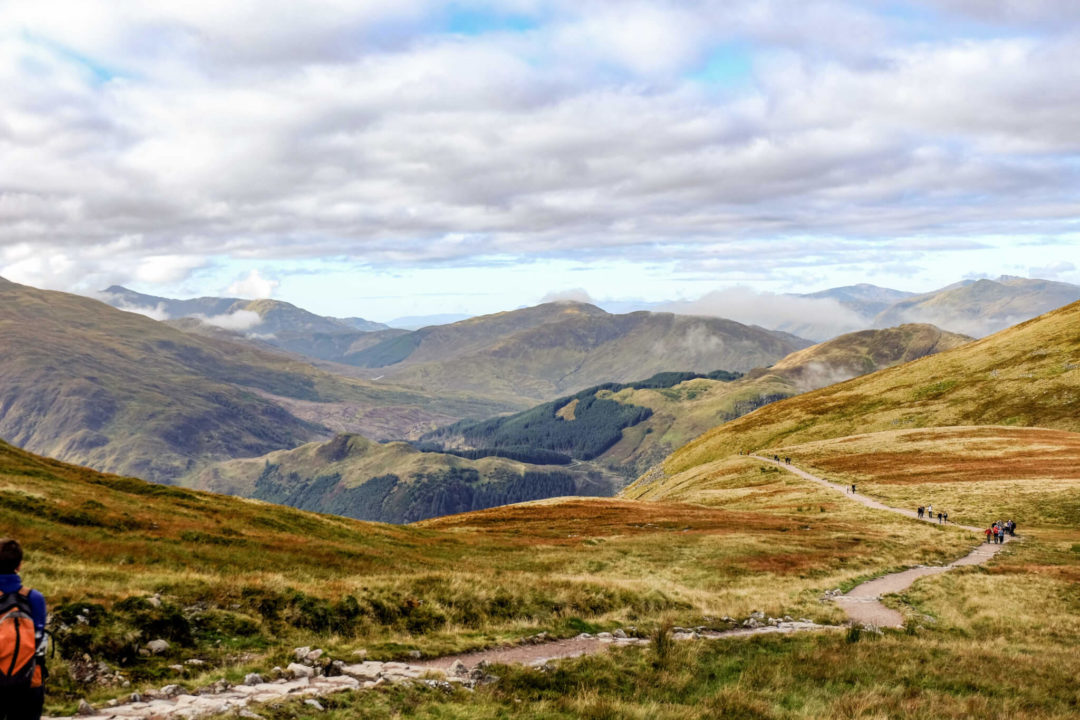
After the lochan, the path crosses the Red Burn, a useful water source if you have a filter (don’t drink from it unfiltered). Beyond the burn begin the infamous upper zigzags.
This is where Ben Nevis starts to hurt. The zigzags are well maintained but relentless, each one shorter than the last as the ground gets rougher. The path changes from good track to shale, loose rock and boulders. Go slowly, keep a steady pace, and don’t cut the corners: it causes erosion and barely saves any time.
Stage 3: The summit plateau
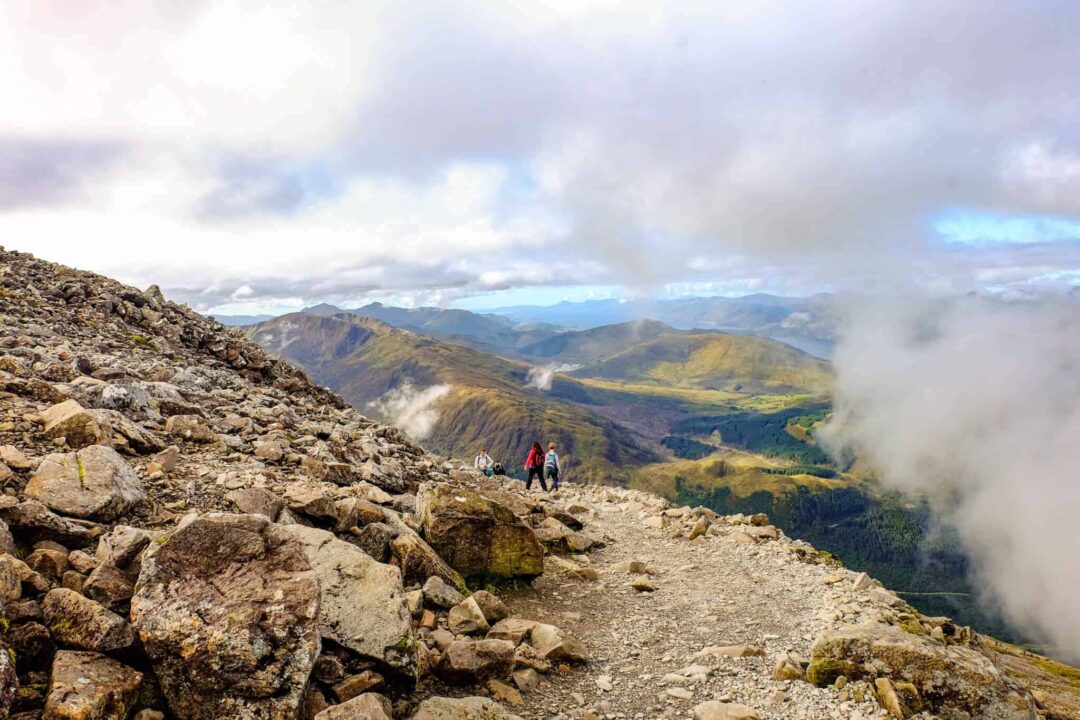
Above the zigzags, the gradient eases as you reach the edge of the summit plateau. The path passes Five Finger Gully, then Tower Gully and finally Gardyloo Gully. All three are serious hazards in poor visibility, and walkers have fallen to their deaths here.
A line of cairns marks the way to the summit. In very low cloud you won’t be able to see from one cairn to the next, and you’ll need to decide whether you can navigate safely to the top, which is about 150 metres away at this point. In heavy snow, the cairns can be buried.
If you’re caught with no visibility, this is where your compass comes in. To get back down from the summit cairn, walk 150 metres on a bearing of 231°, then follow a bearing of 282° to reach the top of the Mountain Path zigzags, as shown on this map. Learn to take a bearing and practise mountain navigation before you go. This video shows you how to take a bearing.
The summit has the ruins of the old observatory, a trig point and an emergency shelter, and on a clear day you can see all the way to Northern Ireland. On most days, though, you’ll be in thick cloud.
How long does it take to climb Ben Nevis?
Most walkers take 7–9 hours for the round trip.
- Visitor Centre to the Halfway Lochan: 1.5–2 hours
- Halfway Lochan to the top of the zigzags: 1–1.5 hours
- Top of the zigzags to the summit: 30–45 minutes
- Total ascent: around 4–4.5 hours
- Descent (summit to Visitor Centre): 2.5–3.5 hours
Fast, fit walkers do it in 5–6 hours. Allow 9–10 hours if you’re less experienced, taking it steady, or the weather is difficult. Starting by 9am in summer gives you plenty of daylight to spare.
Is Ben Nevis hard to climb?
Honestly? Yes. But most reasonably fit people with proper preparation can do it.
The Mountain Path isn’t a technical climb: in summer you don’t need ropes, specialist equipment or mountaineering experience. But it is long, steep and relentless. You climb 1,345 metres from near sea level, and the descent is harder on your knees than the way up.
You’re ready to attempt Ben Nevis if you:
- Regularly walk 10+ miles comfortably
- Have done some smaller hills first (a few beginner Munros is ideal, or start with my hills for beginners)
- Are comfortable on uneven, rocky ground
- Have the right kit (see below)
Build up more experience first if you:
- Rarely walk more than a few miles at a time
- Haven’t done any significant uphill walking
- Are relying on fair weather to make it achievable
Mountain Path or the Carn Mòr Dearg Arête?
There are two main ways up Ben Nevis. The Mountain Path is the one for almost everyone. The Carn Mòr Dearg (CMD) Arête is the mountaineer’s route: a horseshoe that climbs neighbouring Carn Mòr Dearg first, then crosses a narrow, curving rocky ridge to Ben Nevis, with the great cliffs of the north face across the corrie beside you.
| Mountain Path | CMD Arête | |
|---|---|---|
| Who it’s for | Fit beginners | Experienced hillwalkers with scrambling experience and a head for heights |
| Scrambling | None | Grade 1 scrambling on a narrow, exposed ridge |
| Time | 7–9 hours | A longer day: allow 10 hours or more |
| Start | Glen Nevis Visitor Centre | North Face car park at Torlundy |
| Munros | One (Ben Nevis) | Two (Carn Mòr Dearg and Ben Nevis) |
| Crowds | Busy in summer | Much quieter |
| Views | Glen Nevis on the way up, then usually cloud | The north face cliffs and the arête itself |
| In winter | A winter mountaineering route | A serious winter mountaineering route |
The CMD Arête is thrilling in good summer conditions, but once you’re on the ridge there’s no easy way off, and in wind, rain or snow it becomes very serious. Most people come down by the Mountain Path. Don’t attempt it without experience of exposed ridges, and if you’re unsure, go with a qualified guide.
When not to climb Ben Nevis
Knowing when to stay at the bottom matters as much as knowing the route. Don’t set off, or turn back, if:
- It’s between October and April, unless you have winter skills and kit (ice axe, crampons and the experience to use them). Snow and ice cover the plateau, and cornices overhang the north face gullies.
- There’s snow on the upper path, even in May or June. Treat it as a winter route.
- The summit forecast shows thick cloud and you can’t navigate with a map and compass. The plateau is where people go wrong.
- Winds near the summit are forecast above about 20mph.
- You can’t reach the top with plenty of daylight to spare. Set yourself a turn-back time before you start and stick to it.
Turning back is never a failure. The mountain will still be there.
Is Ben Nevis dangerous?
In good weather with the right preparation, the risk is manageable. But Ben Nevis has a serious safety record, and complacency causes accidents. The main hazards are:
- Rapid weather changes – it can be warm and sunny in the glen and freezing with zero visibility at the summit on the same day. The mountain averages only around 14 clear summit days a year.
- Navigation in fog – the summit plateau is confusing, and people have walked off the edges of Tower Gully and Gardyloo Gully in poor visibility. If you can’t see clearly, don’t go to the summit.
- Descent fatigue – most accidents happen on the way down, when you’re tired and your knees are taking a beating. Leave plenty of time and energy.
- Underestimating the conditions – snow can lie on the upper path from September to July. If there’s snow, you’ll need an ice axe, crampons and the skills to use them.
Carry a map and compass and know how to use them. Never rely only on your phone’s GPS.
Ben Nevis weather: what to expect
Ben Nevis has its own microclimate, and the dedicated Ben Nevis weather forecast often shows conditions very different from Fort William in the glen below.
- The summit can be 15–20°C colder than the glen
- The average wind speed at the summit is around 30mph
- Ben Nevis averages around 14 clear summit days a year
- Snow can lie on the upper path from September to July, and sometimes into August
Check more than one forecast before you go:
When is the best time to climb Ben Nevis?
The best months are May and September.
- May: long days, quieter paths, snow retreating from the lower sections, and fewer midges.
- June to August: the most daylight and the warmest weather, but by far the busiest. Weekend car parks fill by 8am, and you’ll want my midge survival guide.
- September: quieter than summer, still manageable conditions, and beautiful autumn light.
- October to April: treat it as a winter mountaineering route. Snow, ice and poor visibility mean you need crampons, an ice axe and proper mountain skills.
What to pack for Ben Nevis
Clothing
- Waterproof jacket (essential, even in sunshine)
- Waterproof trousers
- Warm mid layer (a fleece or down jacket)
- Hat and gloves (even in summer, it’s often below freezing at the summit)
- Moisture-wicking base layer
- Sturdy, ankle-supporting walking boots – not trainers or casual shoes
- Good walking socks (wool or synthetic, not cotton)
Food and water
- At least 2 litres of water
- High-energy snacks: flapjacks, nuts, energy bars, sandwiches
- A hot drink in a flask – very welcome at the summit
- More food than you think you need
Navigation
- Printed OS map (Landranger 41 or Explorer 392) in a map case
- A compass, and the skills to use it. If there’s a chance of bad weather, don’t risk the climb, or go with a Ben Nevis guide
Safety
- Phone with OS Maps downloaded for offline use
- Portable battery pack (the cold drains phone batteries fast)
- Head torch (even in summer, descents can run late)
- Basic first aid kit
- Emergency bivvy bag or foil survival blanket
- Sun cream and sunglasses
Tell someone your plan. Before you go, let someone know your route, when you expect to be back, and what to do if they don’t hear from you.
More ideas in my Scotland packing list.
Where to stay near Ben Nevis
Booking somewhere for the night before and starting early is strongly recommended, especially in summer.
- Glen Nevis Youth Hostel – the closest to the start of the climb, less than a mile away
- Ben Nevis Inn – right at the foot of the Mountain Path, with a well-earned pint at the end
- Fort William town centre – a wide range of hotels, B&Bs and guesthouses, 10–15 minutes from the start
So how did I find climbing Ben Nevis?
I struggled. I doubted myself on those zigzags. I hit the fog at around 1,200 metres and couldn’t see more than 20 metres in any direction. Then I reached the top, ate a slightly squashed sandwich, took a photo in the freezing wind, and started back down.
If you’re reasonably fit, properly prepared and respect the mountain, you can do this. Plan carefully, choose the right day, and don’t underestimate the descent.
Ben Nevis FAQs
How long does it take to climb Ben Nevis?
Most walkers take 7 to 9 hours for the round trip on the Mountain Path: about 4 hours up and 3 hours down. Fast, fit walkers can do it in 5 to 6 hours. Allow 9 to 10 hours if you’re less experienced or the weather is poor.
Is Ben Nevis hard to climb?
Yes, but it isn’t technical. The Mountain Path has no scrambling, but it’s 17.7km long with 1,345 metres of ascent, and the upper half is steep, rocky and relentless. Most reasonably fit people who have done some hill walking can manage it with proper preparation.
Where is Ben Nevis?
Ben Nevis is in Lochaber in the Scottish Highlands, about four miles east of Fort William. The Mountain Path starts at the Glen Nevis Visitor Centre, 1.5 miles from Fort William town centre.
Can beginners climb Ben Nevis?
Yes, fit beginners can climb it by the Mountain Path between May and September. You should be comfortable walking 10 miles or more and have done some uphill walking first. Beginners should avoid the Carn Mòr Dearg Arête and any winter ascent.
When is the best time of year to climb Ben Nevis?
May and September give the best balance of daylight, conditions and crowds. June to August is the busiest time. From October to April, Ben Nevis is a winter mountaineering route that needs an ice axe, crampons and the skills to use them.
Where do you park to climb Ben Nevis?
Most people park at the Glen Nevis Visitor Centre, which has around 80 spaces, toilets and a daily charge, and fills early on summer weekends. There is also a small free car park near the Ben Nevis Inn at Achintee and the Braveheart car park at the entrance to Glen Nevis. From May to September you can take the seasonal Glen Nevis bus from Fort William instead.
Do you need a guide to climb Ben Nevis?
Not for the Mountain Path in summer if you’re fit, well equipped and can navigate with a map and compass. A qualified guide is a good idea if you can’t navigate, if the forecast is poor, for the Carn Mòr Dearg Arête, and for any winter ascent. Look for a qualified Mountain Leader or, in winter, a Winter Mountain Leader or Mountaineering Instructor.
Do I need walking boots to climb Ben Nevis?
Yes. The upper path is rocky, uneven and often wet, icy or snowy, so ankle-supporting waterproof walking boots are essential. Trainers are not suitable. If there is snow on the path, you need crampons.
Are there toilets on Ben Nevis?
Only at the Glen Nevis Visitor Centre at the start. There are no facilities on the mountain, so use them before you set off.
Is there a cable car up Ben Nevis?
No. The Nevis Range gondola goes up Aonach Mòr, a neighbouring mountain, not Ben Nevis. The only way to the top of Ben Nevis is on foot.
What should I do if the weather turns bad on Ben Nevis?
Turn back. If you are caught in fog near the summit and can’t see the path, use your compass: from the summit cairn, walk 150 metres on a bearing of 231°, then follow a bearing of 282° to reach the top of the Mountain Path zigzags.
Can children climb Ben Nevis?
Older children, roughly 10 and over, with good stamina and walking experience can climb Ben Nevis with the right preparation. It is a very long day on rough ground, so it isn’t recommended for younger children.
How hard is Ben Nevis compared to other Scottish mountains?
It’s more demanding than most beginner Munros because of its height and the amount of ascent. If you can climb Ben Lomond comfortably, you have a good foundation for Ben Nevis.
Useful links
- Walkhighlands: Ben Nevis Mountain Path
- Ben Nevis weather forecast
- MWIS West Highlands forecast
- Met Office Ben Nevis forecast
- Nevis Landscape Partnership
Read next: Munros for beginners · Hills for beginners in Scotland · Things to do in Fort William · How to visit Glencoe
Love from Scotland x


Leave a Reply