Scotland is known for ts vast landscapes, Munros and long-distance trails, but some of the most memorable walks are often hidden.
Across the country, you’ll find dens, glens and gorges: short, steep-sided ravines carved by burns and rivers.
During the 18th and 19th centuries, estate owners and early visitors recognised the appeal of Scotland’s river gorges and added paths, steps and bridges to make them accessible.
Here are some of the best dens, glens and gorge walks in Scotland.
1. Puck’s Glen – a Victorian gorge walk, Argyll
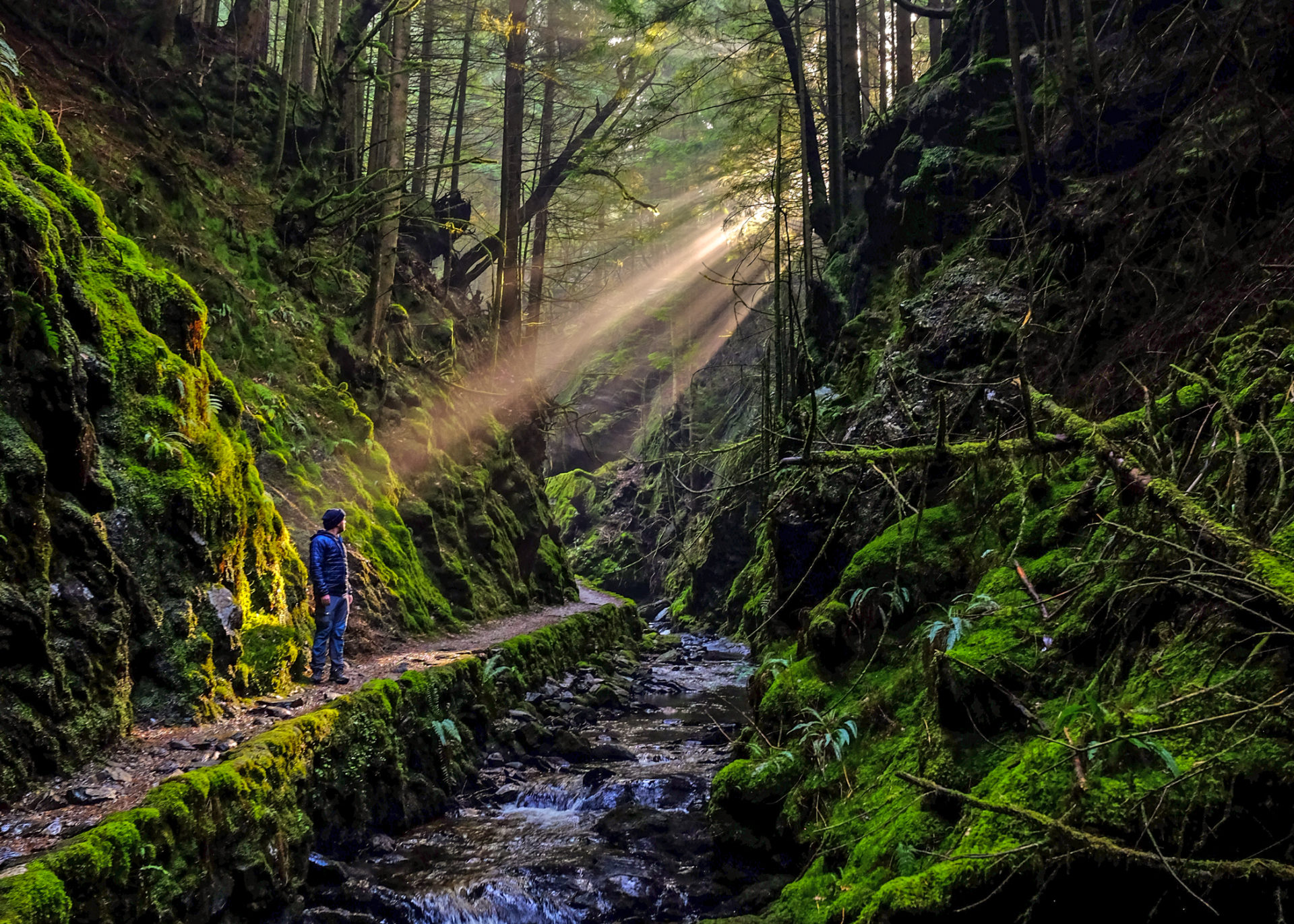
Puck’s Glen is one of the best-known gorge walks in Scotland and a classic example of a Victorian-designed den.
Named after the mischievous sprite in Shakespeare’s ‘A Midsummer Night’s Dream, the walk drops quickly into a narrow ravine, where the burn rushes through moss-covered rock walls.
Wooden bridges and boardwalks lead you back and forth across the water, while steep stone steps climb steadily through the gorge.
- Good to know: Puck’s Glen is currently closed to visitors (at December 2025) and will reopen in 2026.
- Walk distance: 1.5–2 km. Time: 45 minutes – 1.5 hours. Difficulty: Moderate
- Parking: Puck’s Glen car park near Benmore
- Facilities: Toilets and café at Benmore Botanic Garden
- Visit Puck’s Glen and explore Cowal
2. The Linn of Tummel – easy gorge walk with powerful river views
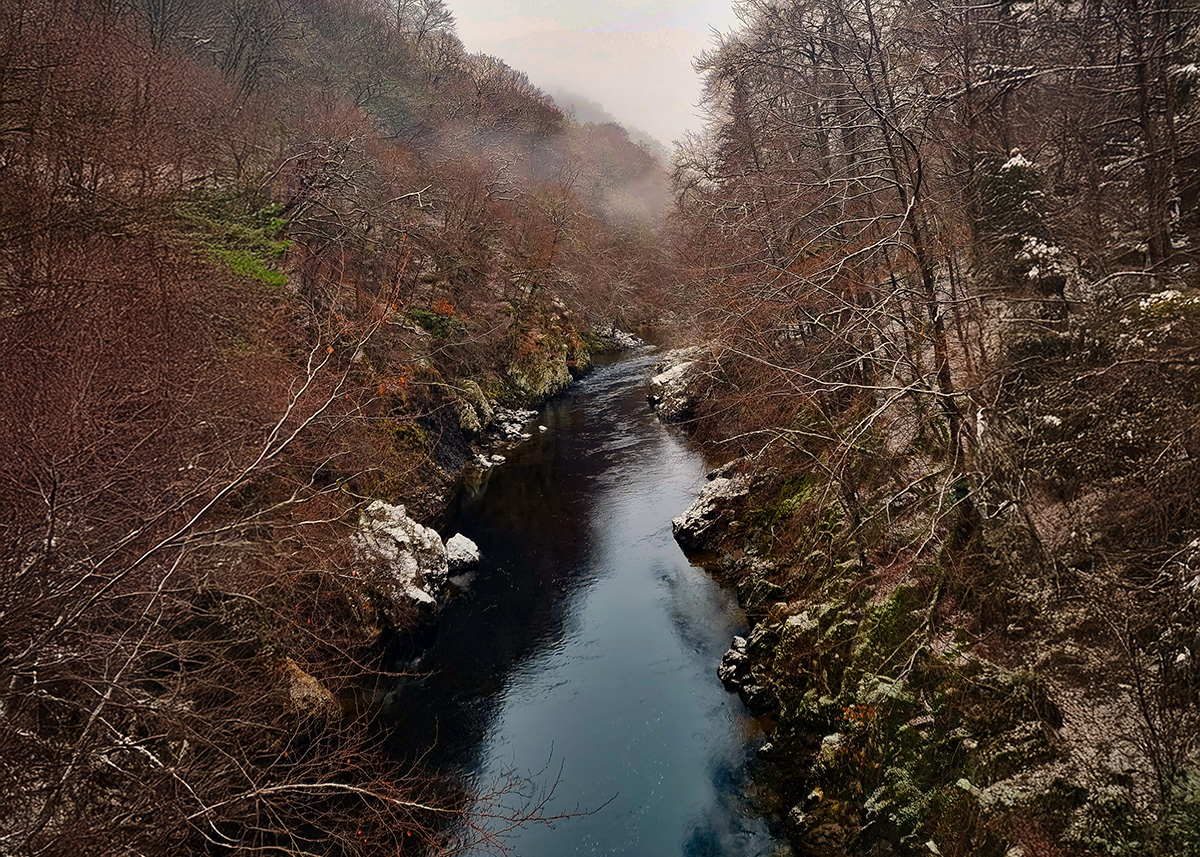
The Linn of Tummel is one of the most impressive river gorges in Perthshire.
Located just outside Pitlochry, it sits on the River Tummel where the water narrows and accelerates through a rocky channel.
The walk follows a well-made path through woodland to a series of viewpoints overlooking the gorge. From here, you can look down into the river as it surges through the linn below,
- Walk distance: approx. 1–1.5 km. Time: 30–45 minutes. Difficulty: Easy
- Parking: Linn of Tummel car park (signed from Pitlochry)
- Facilities: Toilets, cafés and shops in Pitlochry
- Good to know: Viewpoints are close to steep drops; take care in wet or icy conditions
3. Reelig Glen – a woodland gorge walk with Britain’s tallest trees
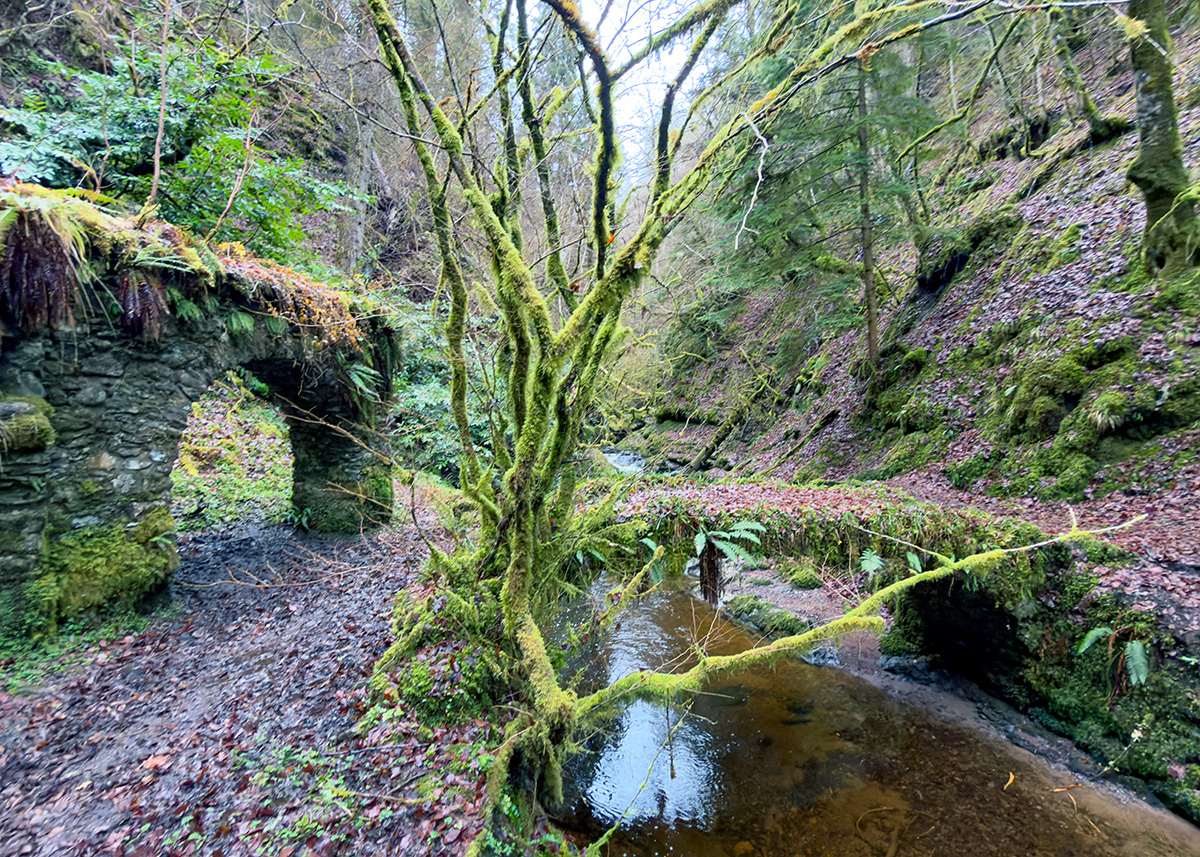
Once part of the Reelig House estate, Reelig Glen is known for the scale of its woodland rather than waterfalls.
Sheltered by the steep sides of the glen, it supports some of the tallest trees in Britain, including Douglas firs over 65 metres tall, as well as Britain’s tallest larch and lime tree.
Many of these trees are thought to have been planted by James Baillie Fraser (1783–1856), a Scottish traveller and explorer who owned the estate.
At the upper end of the walk is a small stone bridge and grotto known as Tigh an Aigh.
During the 1840s, Fraser carried out improvement works here as a form of employment during the Highland Clearances.
According to local tradition, workers believed the glen to be inhabited by fairies or spirits after returning to find their previous day’s work disturbed, giving rise to its long-standing nickname, the Fairy Glen.
- Walk distance: 1.5–2.5 km. Time: 45 minutes – 1.5 hours. Difficulty: Easy
- Parking: Reelig Glen car park
- Facilities: None
- Read more – the best walks near Inverness
4. The Hermitage – the classic woodland gorge walk in Perthshire
The Hermitage is one of Scotland’s best woodland walks and a key influence on later gorge and glen routes.
Created in the 18th century as a pleasure garden for the Dukes of Atholl, it remains a classic example of designed landscape.
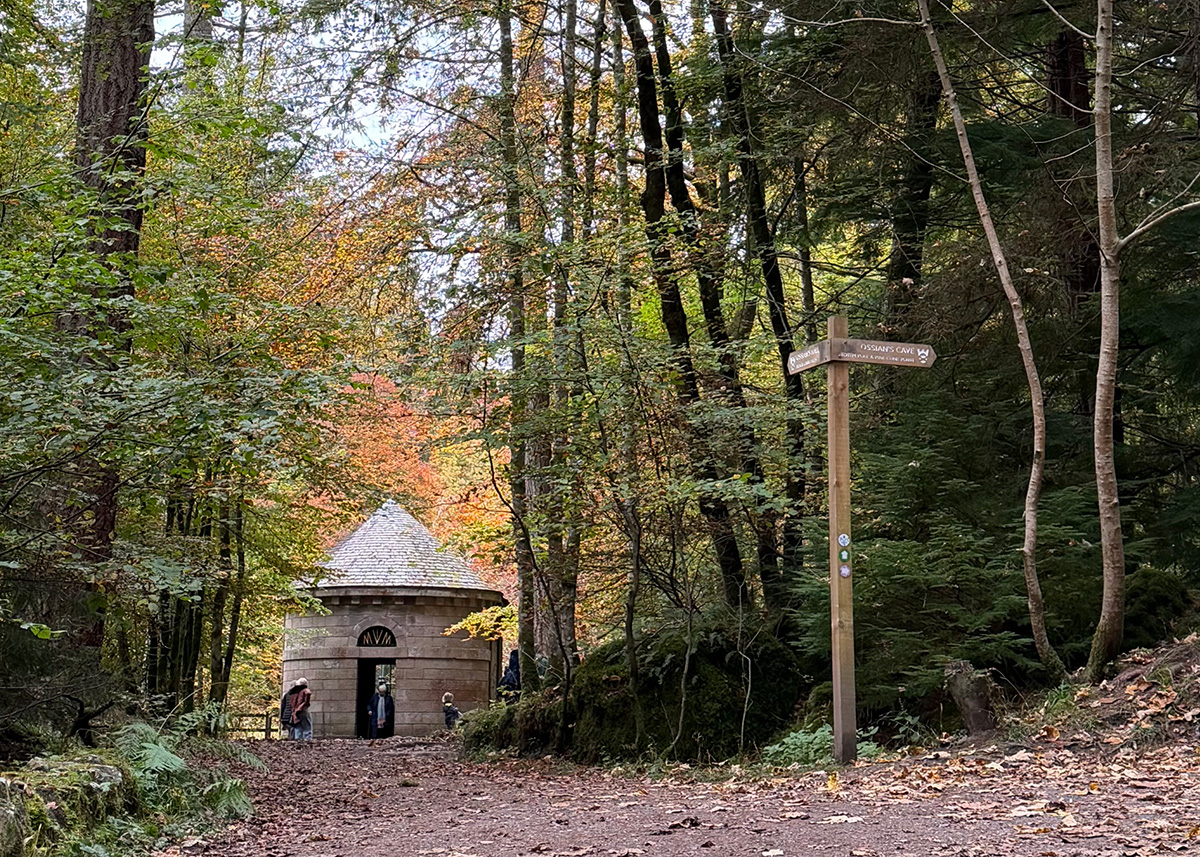
Set within Craigvinean Forest, the walk leads through towering Douglas firs to the River Braan and Ossian’s Hall.
Originally built in 1782, the folly once featured mirrors, sliding panels and paintings, all designed to frame views of the Black Linn Falls below.
The Hermitage is particularly popular in autumn, when the woodland colours are at their best, and red squirrels are often spotted among the trees.
Discover the Hermitage with this guide from the National Trust for Scotland.
- Good to know: The Hermitage is very popular on social media so can be exteremly busy at times. Check their facebook page for car park capacity.
- Walk distance: 2–3 km. Time: 1–1.5 hours. Difficulty: Easy
- Parking: Hermitage car park (National Trust for Scotland)
- Facilities: Toilets and cafés in Dunkeld
- How to visit Perthshire
5. Burn o’ Vat – a short glacial gorge walk to a natural rock bowl
Burn o’ Vat is one of the most unusual short gorge walks in Scotland.
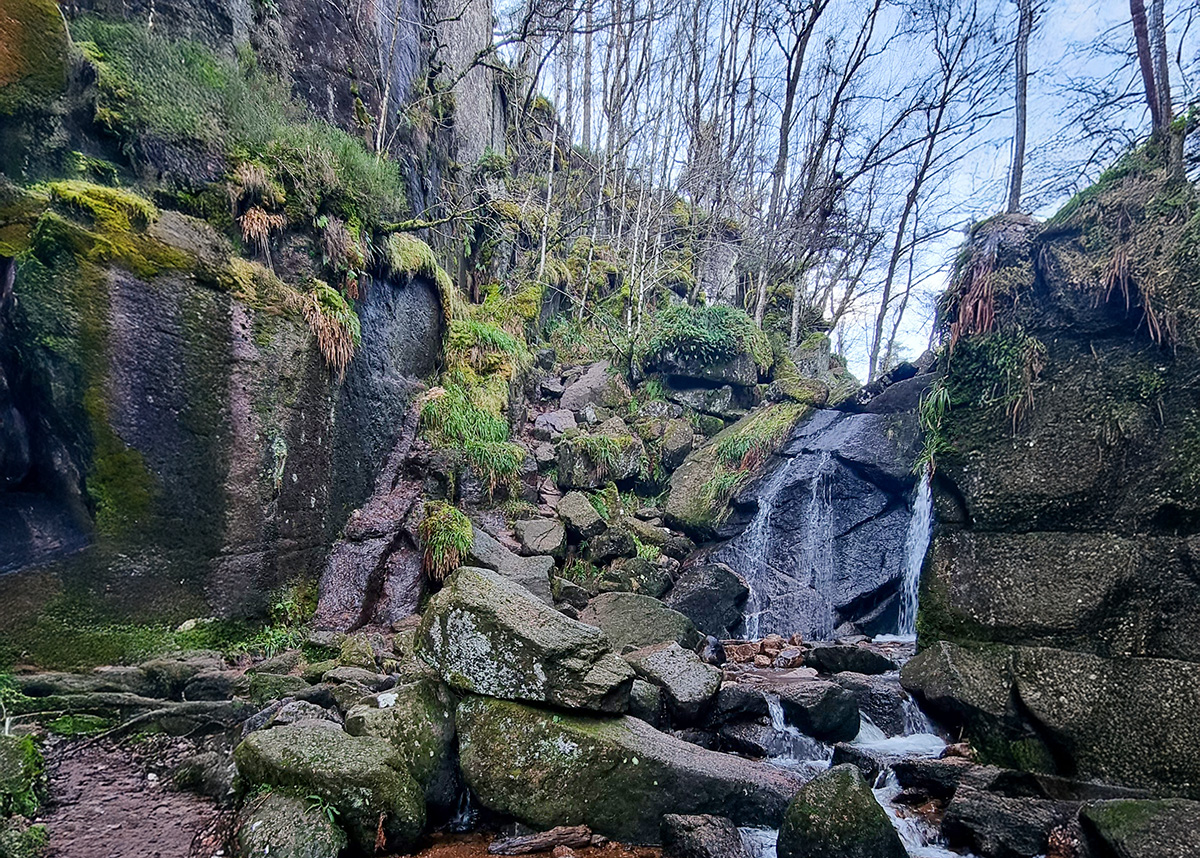
Set within the Muir of Dinnet National Nature Reserve, it leads to a huge natural bowl carved by glacial meltwater.
The walk follows a wide woodland path before narrowing into a dramatic rock cleft, where the burn disappears into the circular “vat” below.
- Walk distance: approx. 1 km. Time: 30–45 minutes. Difficulty: Easy
- Parking: Burn o’ Vat car park (Muir of Dinnet NNR)
- Facilities: Muir of Dinnet Visitor centre nearby
- Good to know: Short uneven section through rocks at the vat entrance; manageable for most walkers.
6. Maspie Den – a historic waterfall walk, Fife
Once a royal residence and hunting park for Stewart kings and queens, the Falkland Estate now offers some of the best woodland and waterfall walks in Fife.
Maspie Den is one of the finest surviving examples of a Victorian pleasure-ground walk in Scotland.
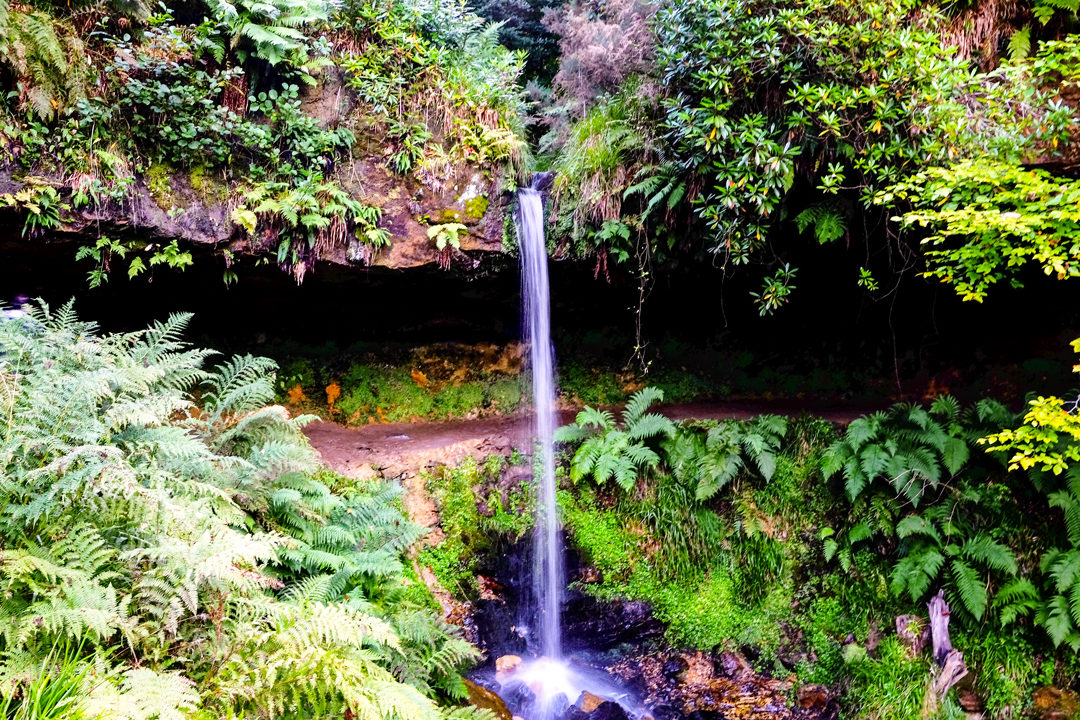
The path climbs a deep, hidden river valley that feels surprisingly enclosed, with waterfalls, stone steps and bridges appearing as you make your way upward.
At the top of the den, a waterfall marks a natural turning point in the walk.
Maspie Den is easy to combine with time in Falkland village or a visit to Falkland Palace.
- Walk distance: approx. 2 km. Time: 1–1.5 hours. Difficulty: Moderate
- Parking: Falkland Estate car parks
- Facilities: Toilets, cafés and shops in Falkland
- Visit Maspie Den
7. Dollar Glen – a dramatic gorge walk to Castle Campbell
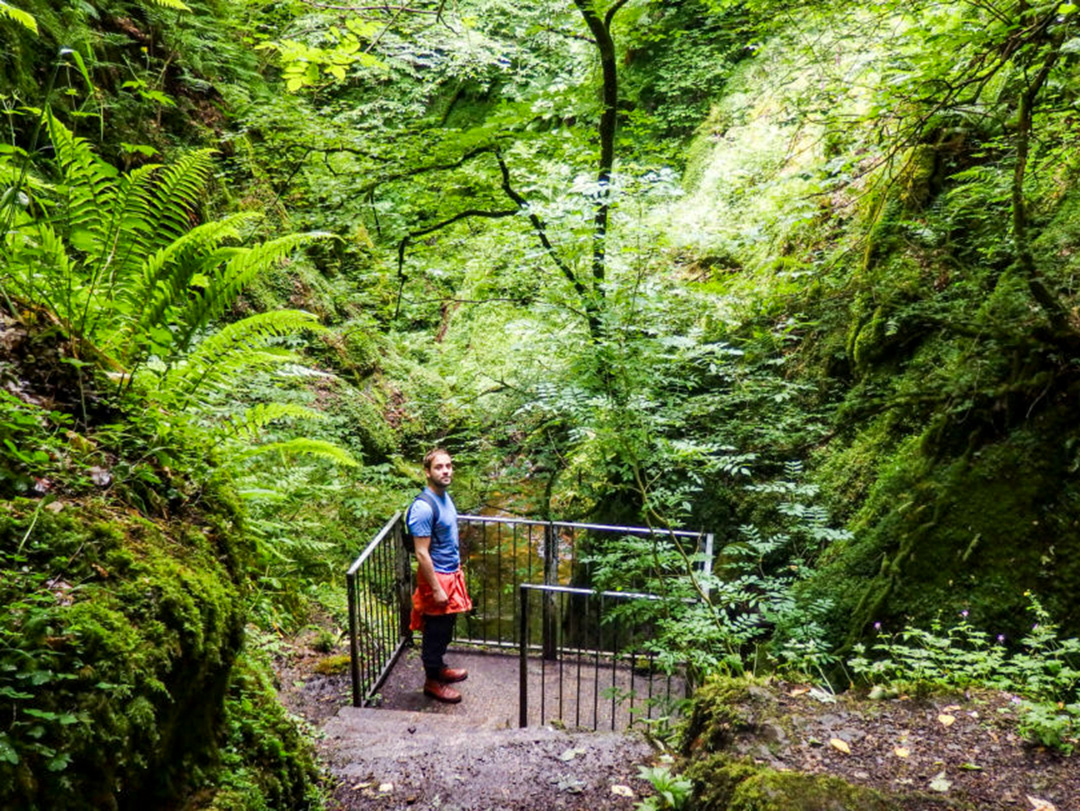
Dollar Glen has been attracting visitors since Victorian times and remains one of the most dramatic gorge walks in central Scotland.
Deep in the glen below Castle Campbell are two narrow chasms, carrying the Burn of Sorrows and the Burn of Care, worn out of the granite rock.
Follow the path into the gorge and you quickly find yourself surrounded by dense greenery, with ferns, mosses and overhanging branches.
The route is laid out with a series of bridges and raised walkways that dip down into crevices, revealing tumbling waterfalls such as the Hempy Falls and repeated glimpses of the castle above.
- Walk distance: 3–4 km. Time: 2–3 hours. Difficulty: Moderate.
- Parking: Dollar Glen car park (National Trust for Scotland)
- Facilities: Cafés in Dollar
- Visit Dollar Glen
8. Devil’s Mill — a dramatic river gorge at Rumbling Bridge
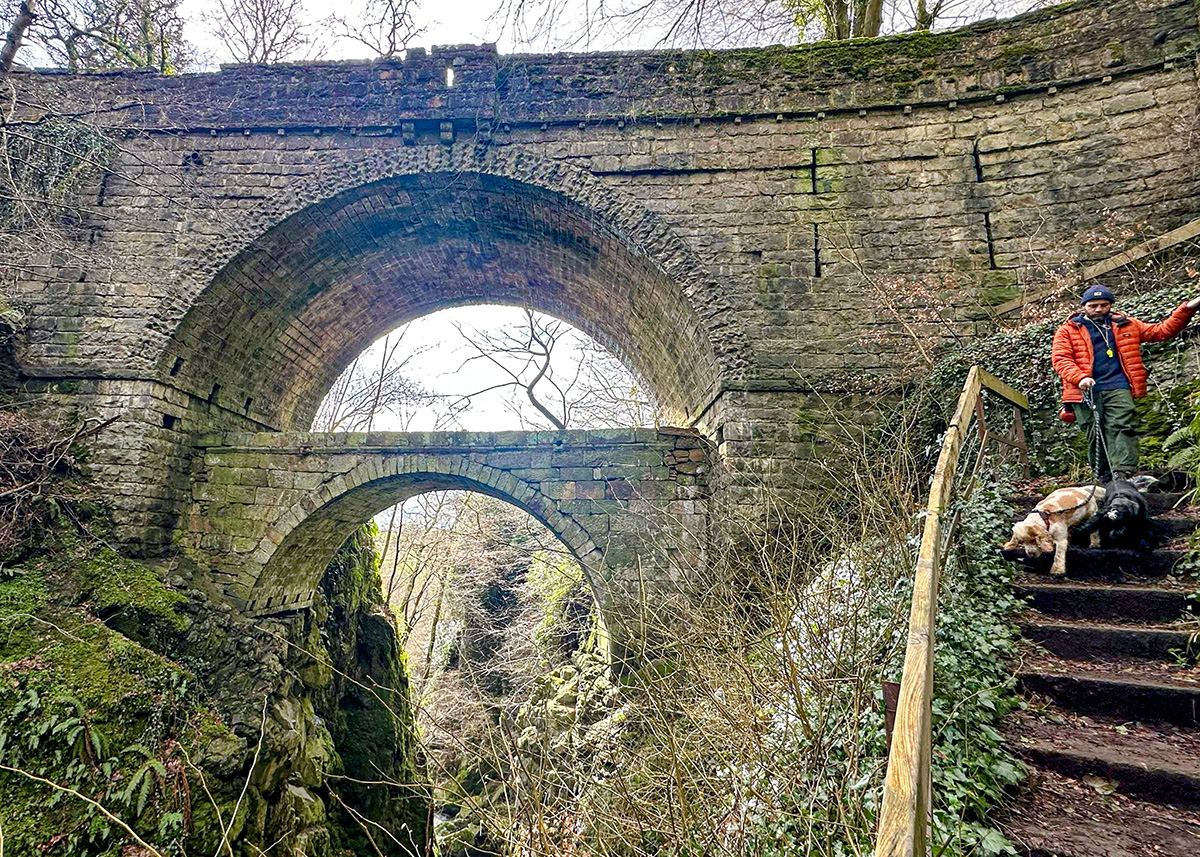
The Devil’s Mill at Rumbling Bridge is one of the most dramatic river gorges in central Scotland.
Here, the River Devon forces its way through a deep, narrow chasm, creating a series of thunderous falls, whirlpools and plunge pools.
The name “Devil’s Mill” reflects the violence of the water as it churns through the rock, while Rumbling Bridge takes its name from the rumbling of traffic going over the dramatic bridge above the gorge.
In the 18th and 19th centuries, paths and viewpoints were laid out to allow visitors to safely experience the spectacle, turning the gorge into an early scenic attraction.
- Walk distance: approx. 1.5–2 km. Time: 45 minutes – 1.5 hours. Difficulty: Moderate
- Parking: On Rumbling Bridge, there is also a small new car park nearby.
- Facilities: None on site; services in nearby villages
- Good to know: Fenced paths but very steep drops; keep children and dogs under close control
9. Big Burn Walk – an easy waterfall walk through a forest gorge
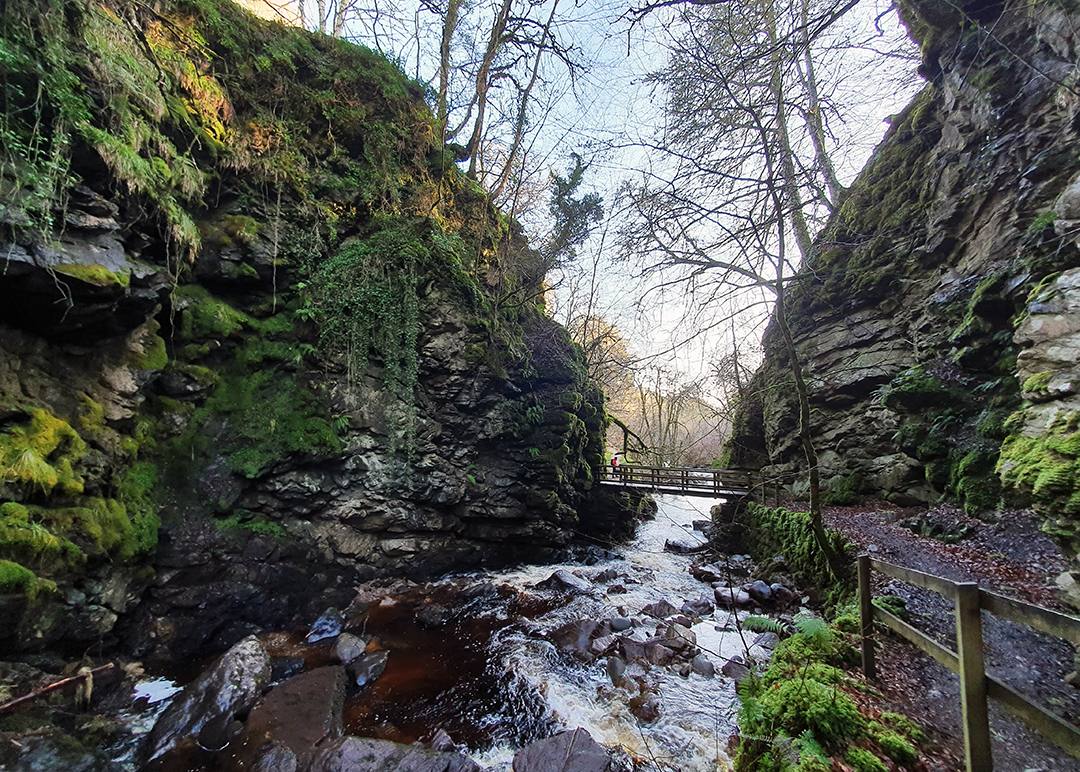
Just beyond Golspie and Dunrobin Castle, the Big Burn offers a short but surprisingly atmospheric gorge walk.
Wooden walkways follow the burn through a narrow, sheltered ravine where waterfalls pour over cliff edges into shaded pools below.
Despite its modest length, the glen feels lush and enclosed, particularly after rain.
- Walk distance: approx. 2 km. Time: 1 hour minutes. Difficulty: Easy–Moderate
- Parking: Small signed car park
- Facilities: Toilets and cafés in Golspie
- How to visit Golspie
10. The Birks of Aberfeldy – famous waterfall walk linked to Robert Burns
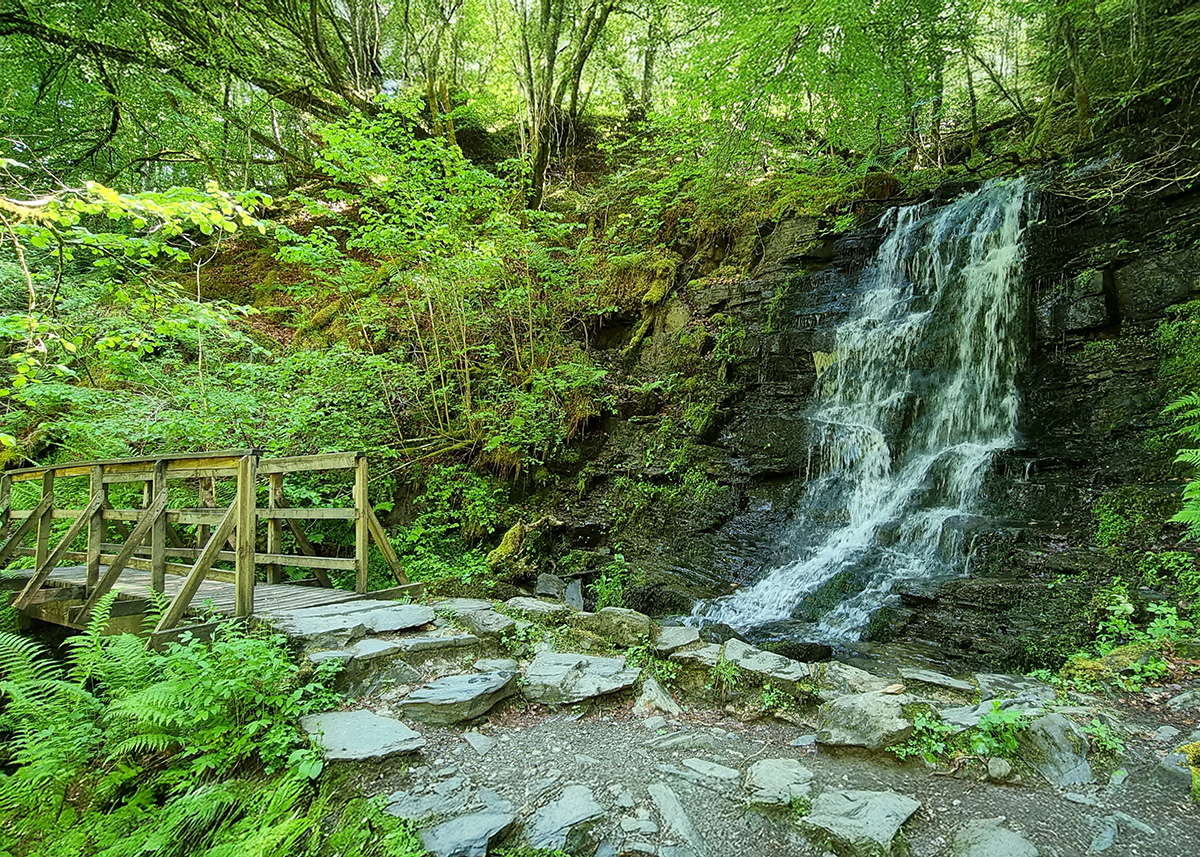
The Birks of Aberfeldy is one of Scotland’s most famous short woodland walks and has attracted visitors for over 250 years.
The route follows the Moness Burn as it tumbles through a wooded gorge on the edge of Aberfeldy, passing a series of waterfalls and cascades.
The walk became widely known after Robert Burns wrote The Birks of Aberfeldy in 1787, celebrating the scenery during a visit to the area.
Today, paths and bridges make the route easy to follow, though there are plenty of steps along the way.
- Walk distance: approx. 2 km. Time: 1–1.5 hours. Difficulty: Easy–Moderate
- Parking: Birks of Aberfeldy car park (near Moness Resort)
- Facilities: Toilets, cafés and shops in Aberfeldy
- Good to know: Well-made paths, but plenty of steps
11. Pittencrieff Park – an urban den walk through a historic glen
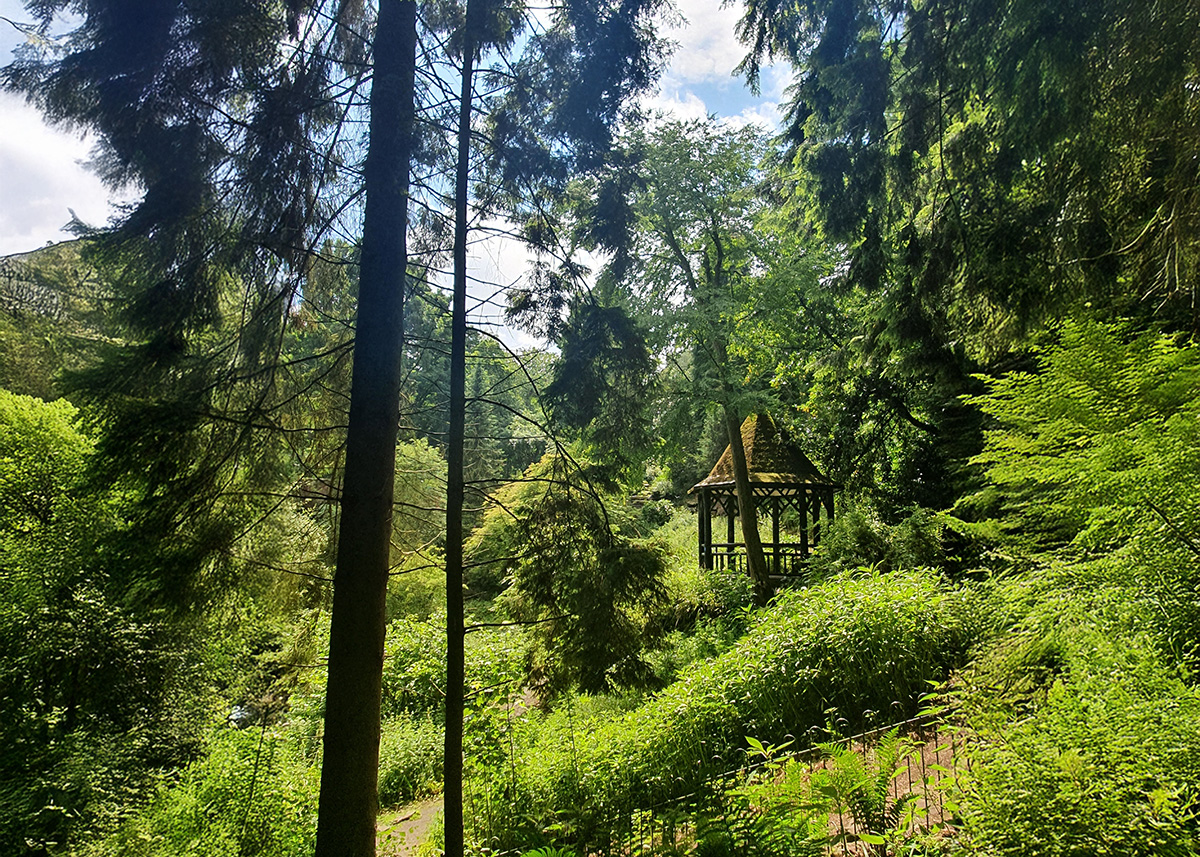
Pittencrieff Park, known locally as “The Glen”, sits at the heart of Dunfermline and contains one of the most accessible den-style walks in Scotland.
Gifted to the town by Andrew Carnegie in 1903, the park combines formal landscaping with a surprisingly deep wooded ravine.
The den follows the Lyne Burn through a shaded gorge with bridges, paths and viewpoints.
It’s a great example of how dramatic glen landscapes were incorporated into urban parks.
- Walk distance: approx. 1.5–2 km (within the park). Time: 45 minutes – 1.5 hours. Difficulty: Easy
- Parking: Multiple car parks around Pittencrieff Park
- Facilities: Toilets, café, play areas and visitor facilities in the park
- Good to know: Very accessible; paths suitable for most abilities
- How to visit Dunfermline
12. Finnich Glen – a narrow gorge walk to the Devil’s Pulpit
Finnich Glen is one of Scotland’s most dramatic gorges, but it is also one of the most hazardous.
The Devil’s Pulpit, made famous by Outlander, lies at the heart of a very narrow, steep-sided ravine.
Access involves muddy paths, steep descents and scrambling.
There are no official paths, and the glen is particularly dangerous after heavy rain.
- Walk distance: approx. 0.5 km. Time: 30–60 minutes. Difficulty: Strenuous / hazardous
- Parking: There is a small amount of car parking at the junction of the A809 and B834.
- Facilities: None
13. Dunino Den – a sacred den and short ravine walk
At Dunino Den, a steep set of stone steps leads down into a narrow ravine where a spring emerges at the base of the rock face.
Carved symbols and small offerings reflect the site’s long association with folklore and ritual.
The visit is best treated as a short stop rather than a walk in its own right, but it’s well worth including if you’re exploring the St Andrews area.
- Walk distance: approx. 0.3 km. Time: 15–30 minutes. Difficulty: Easy
- Parking: Small roadside lay-by near the church
- Facilities: None on site
More dens, glens and gorge walks in Scotland
If you’re looking for even more places to explore, these are also worth seeking out:
- Alva Glen, Clackmannanshire – a quieter alternative to Dollar Glen, with waterfalls and a narrow ravine
- Campsie Glen, Lennoxtown – an informal gorge walk forming the lower route into the Campsie Fells
- Den of Alyth, Perthshire – a short ravine walk following a former mill burn
- Corrieshalloch Gorge, near Ullapool – a Victorian suspension bridge over a deep glacial gorge
- Fairy Glen, Rosemarkie – a short but steep wooded ravine with waterfalls
- Den of Finella, Aberdeenshire – a dramatic gorge linked to Pictish legend
- Crawick Glen, Sanquhar – a small landscaped glen developed during the improvement era
- Deil’s Cauldron, Comrie – short but dramatic gorge where the River Lednock forces its way through a narrow rock cleft.
- Roslin Glen – below Rosslyn Chapel along the River North Esk.
Frequently Asked Questions about dens, glens and gorge walks in Scotland
What is a den in Scotland?
In Scotland, a den usually refers to a short, steep-sided ravine carved by a burn, often wooded and enclosed.
A gorge is similar, but can be larger in scale, with higher rock walls or a wider river cutting through.
Many of Scotland’s dens, gorges and small glens were adapted into walking routes during the 18th and 19th centuries, when paths, steps and bridges were added to improve access.
Are gorge walks in Scotland suitable for beginners?
Many gorge walks in Scotland are ideal for beginners. Routes like the Hermitage, Maspie Den, Pittencrieff Park and Burn o’ Vat are short, well maintained and clearly signed.
However, some locations, such as Finnich Glen, are steep, muddy and potentially dangerous, and are not suitable for inexperienced walkers.
Are these walks suitable for families?
Some are very family-friendly, particularly those with wide paths and gentle gradients, such as Pittencrieff Park, the Hermitage and Big Burn Walk.
Others involve steep steps, narrow paths or drops close to the trail and may not be suitable for young children without close supervision.
If walking with children, choose routes marked as easy and avoid locations with unprotected gorge edges.
Do I need special equipment for gorge walks?
For most den and gorge walks, sturdy footwear with good grip is enough. Paths can be muddy, slippery or uneven, especially after rain.
Walking poles can be helpful on steeper routes, but are not essential for easier walks.
Waterproof clothing is recommended, as many gorge walks are shaded and can feel damp even in dry weather.
Are these walks accessible for wheelchairs or pushchairs?
Most dens and gorge walks are not suitable for wheelchairs or pushchairs due to steps, narrow paths and uneven surfaces.
Some urban parks, such as Pittencrieff Park, offer more accessible paths, but the gorge sections themselves are usually stepped or rough.
Read more: scenic short walks in Scotland
If you enjoyed these dens, glens and gorge walks, you might also like these guides to other short, atmospheric walks across Scotland:
- Best Waterfall Walks in Scotland
A round-up of Scotland’s most impressive waterfalls, from easy woodland walks to more dramatic gorge settings. - Short Walks in Scotland with Big Scenery
Ideal if you want memorable landscapes without long distances or steep ascents. - Best Woodland Walks in Scotland
From ancient forests to Victorian estate woodlands, perfect for sheltered walking in any season. - Outlander Filming Locations You Can Visit
Including dramatic landscapes like Finnich Glen and other atmospheric Scottish locations.
Kate – Love from Scotland x