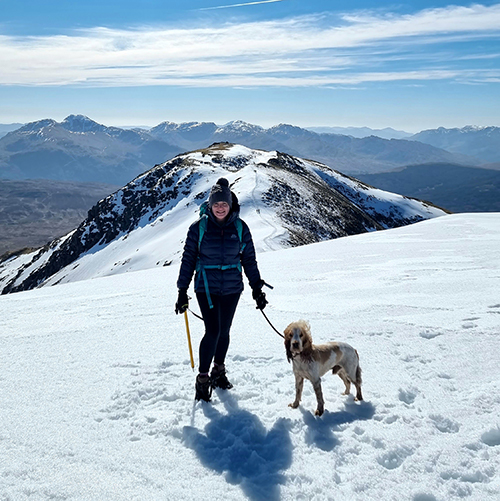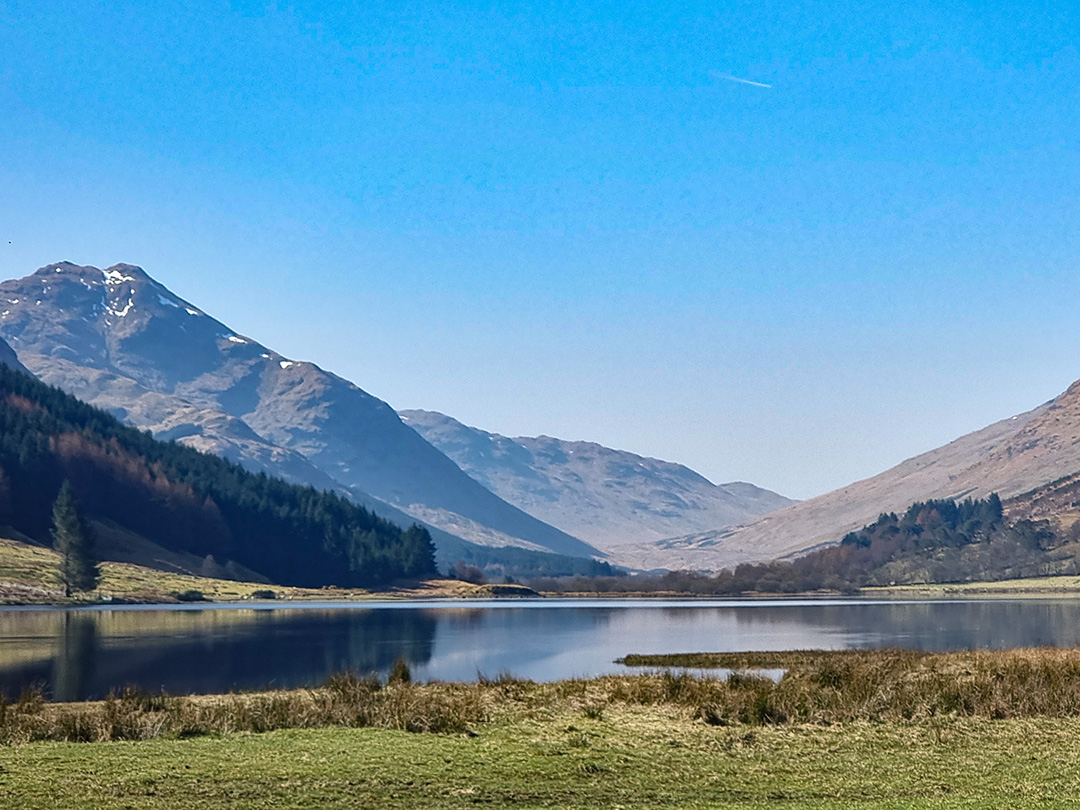
Picture this: snow-capped mountains glowing pink in morning light, glens carpeted in golden daffodils, and the whole of Scotland finally throwing open its doors after a long, dark winter. That is spring in Scotland – and it might just be the best-kept secret in Scottish travel. Discover the magic of Scotland in Spring.
Spring in Scotland runs from March to May and it’s the time of year I look forward to most. The worst of the winter storms are receding, the midges haven’t hatched yet, the crowds haven’t arrived, and everywhere you look something new is blooming, making Scotland in Spring a truly enchanting experience.
I’ve explored this country in every season, I can honestly say spring is consistently one of the best times to visit. Here is everything you need to know to plan your perfect spring trip to Scotland in Spring.
Why spring is one of the best times to visit Scotland
Still weighing up when to visit? Here are six reasons to book your trip between March and May.
The weather is often Scotland’s best
Scotland’s weather is notoriously unpredictable, but in my experience spring is consistently our most stable season.
By April and May, temperatures have climbed to a comfortable 11–15°C (52–59°F), the sharp frosts of winter have lifted, and long spells of clear blue skies are genuinely common.
Yes, you might catch a shower in April, but April is actually one of Scotland’s driest months statistically.
When a Scottish spring day is good, it is really, really good.
No midges
If you’ve visited the Scottish Highlands in summer, you’ll understand the unique misery of the Scottish midge.
These tiny biting insects are the bane of summer visitors, but in spring they simply haven’t hatched yet.
Travel before late May to the west coast (the midge heartland) and your trip should be almost entirely midge-free. It’s always worth packing a midge repellent like Smidge just in case, but you’ll rarely need it.
Scotland in bloom
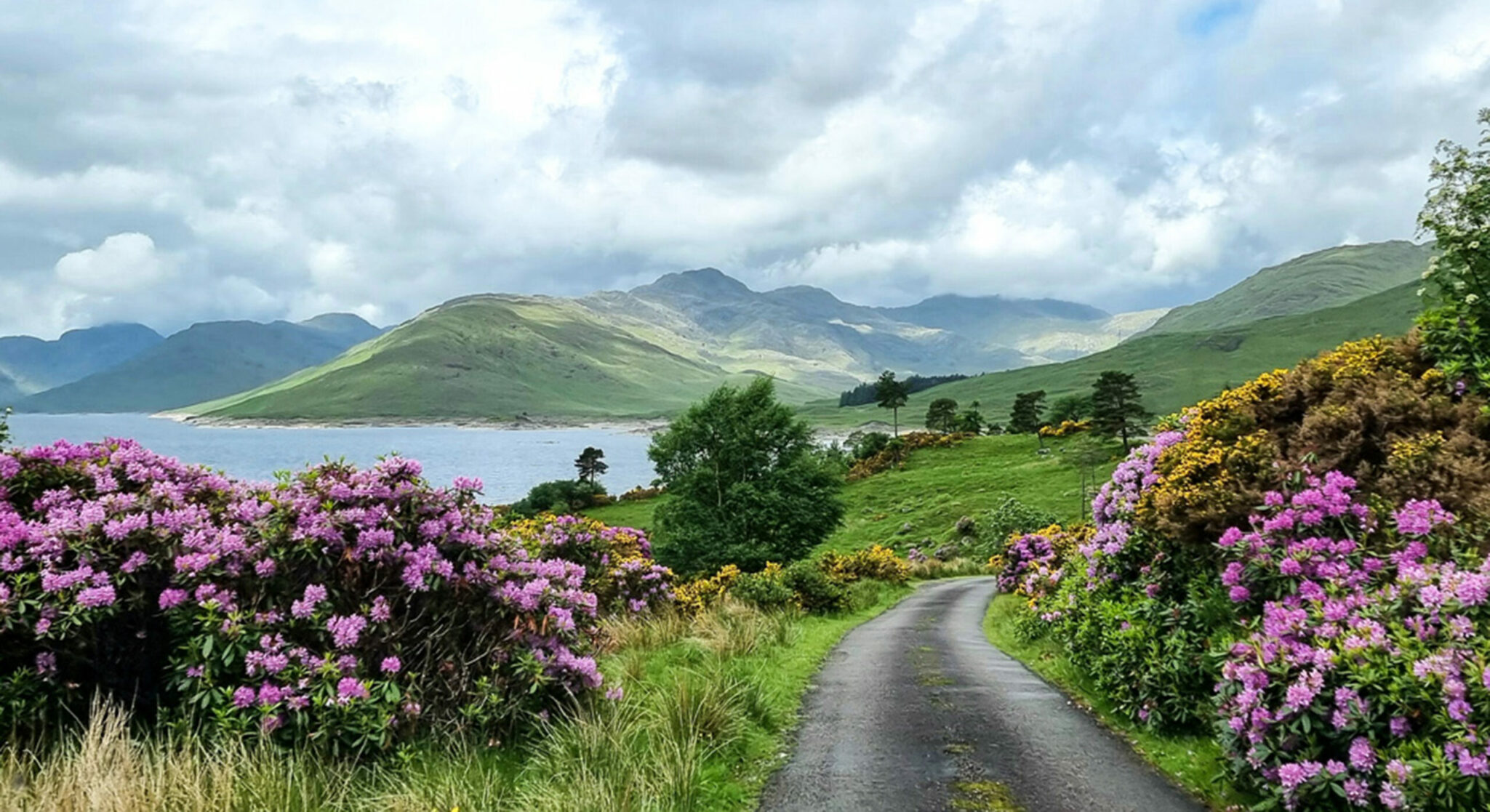
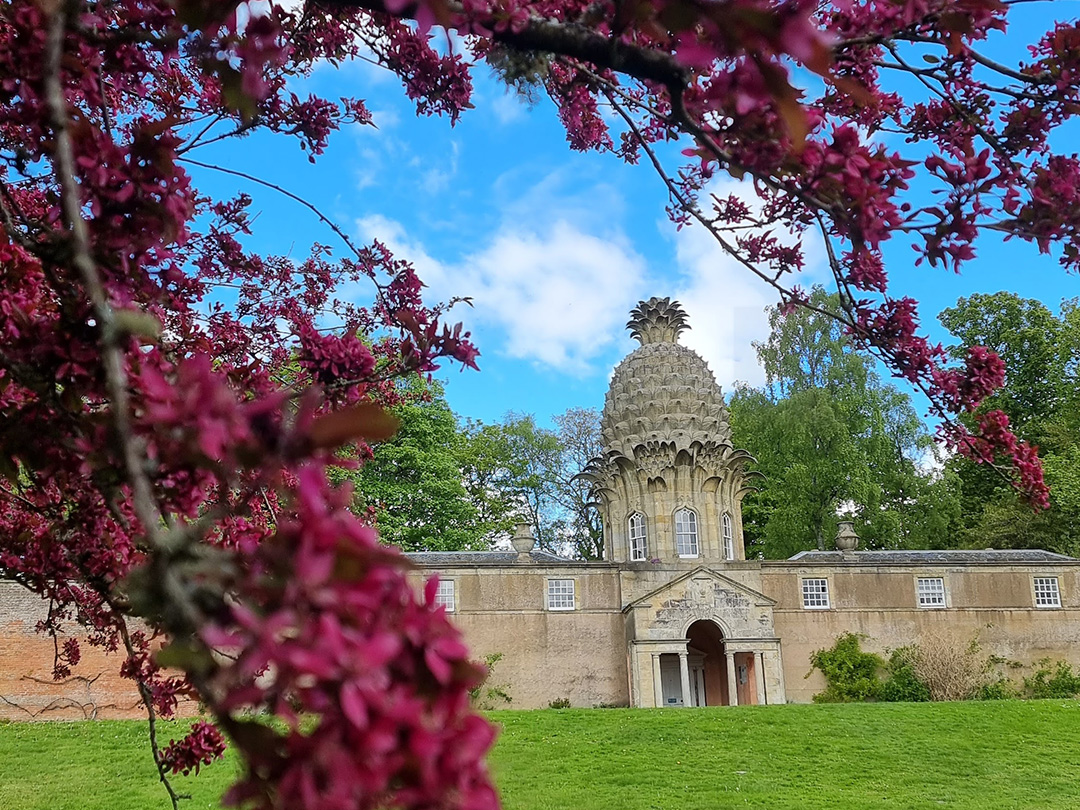
From snowdrops and crocuses in early March to spectacular pink rhododendrons and bluebells by May, Scotland’s spring display is genuinely breathtaking.
You’ll find cherry blossoms in Edinburgh’s Meadows park, camellias and azaleas in grand estate gardens, vivid yellow gorse along roadsides, and purple saxifrage clinging to Highland hillsides.
The country is literally blooming and it’s a photographer’s dream.
Quieter crowds, lower prices
Spring and autumn are Scotland’s shoulder seasons, which means fewer campervans on single-track roads, no queues at popular viewpoints, and considerably more choice in where to stay.
The Isle of Skye, the North Coast 500, and Glencoe are magical in spring – and you can actually stop at a passing place without six cars behind you.
Accommodation prices are noticeably lower than in July and August too.
The only exception is the Scottish school Easter break, typically late March to early April, when popular spots get a little busier.
Scotland is back open for business
Many of Scotland’s visitor attractions – National Trust for Scotland and Historic Scotland – close over winter and reopen around Easter weekend or 1 April.
This means that from April onwards you have access to the full sweep of Scottish experiences, with far fewer visitors than in summer.
If you’re travelling in March, always check opening times in advance, as some attractions may still be closed.
Glorious daylight hours
By the end of May Scotland has up to 17 hours of daylight a day.
Even in March you have around 10 usable hours of light, more than enough to explore.
Scotland’s winter darkness is genuinely difficult, so the return of long evenings in spring feels wonderful to Scots!
Things to do in Scotland in spring
Spring in Scotland is packed with events, wildlife highlights, and outdoor adventures. Here’s a month-by-month guide to the best things to do.
For a full calendar of events, see my complete Scotland events and festivals guide, with links to March 2026 | April 2026 | May 2026

Things to do in March in Scotland
March is the bridge between winter and spring. Expect some cold days and the occasional snow, especially in the Highlands — but also plenty of crisp blue-sky days and the first flowers of the year.
Watch the Six Nations Rugby — Edinburgh is electric on match days at Murrayfield. Even without a ticket, the city atmosphere is unforgettable. Scotland home fixtures – Sat 14 Feb 2026 vs England; Sat 7 Mar 2026 vs France, at Scottish Gas Murrayfield. If you miss the Six Nations Rugby, the Melrose Sevens in the Scottish Borders is a wonderful spring alternative.
Head to St Andrews for StAnza — Scotland’s International Poetry Festival takes place in mid-March in the beautiful historic town of St Andrews. A wonderful, often-overlooked event. Find out more – StAnza Poetry Festival
Visit Scotland’s Daffodil Festival — the Backhouse Rossie Estate in Cupar, Fife, hosts Scotland’s Daffodil Festival with its national collection of Narcissus. Brodie Castle in Moray is also home to the National Daffodil Collection, with around 400 varieties.
Walk through snowdrop woodlands — several estates in Perthshire and Angus open their grounds for guided snowdrop walks in late February and early March. This is a uniquely Scottish seasonal pleasure.
Eat your way around Edinburgh — Eat Out Edinburgh runs throughout March, with discounts and special menus across the city. The Fife Food and Drink Week also takes place in mid-March. Bookings and offers are live now online.
Explore Glasgow’s comedy scene — the Glasgow International Comedy Festival (late March) brings Scottish and international comedians together for a packed programme across the city. Find out more Glasgow International Comedy Festival, the full programme is live with 500+ shows.
For a full calendar of events, see my complete guide to March 2026.
April in Scotland
April is when Scotland truly comes alive. Attractions reopen, lambs appear in fields, and the countryside turns vivid green almost overnight.
Go on an Easter Egg hunt — the National Trust for Scotland runs Easter Egg trails at properties across the country, from Craigievar Castle in Aberdeenshire to Culzean Castle in Ayrshire. You can find the nearest egg hunt to you on the National Trust for Scotland‘s website.
Celebrate Beltane on Calton Hill — on 30 April Edinburgh’s ancient fire festival comes to life on Calton Hill with fire performers, drummers and a spectacular pagan ceremony welcoming summer.
Cycle the Étape Loch Ness — this 66-mile cycling sportive around the shores of Loch Ness on the last weekend in April is one of Scotland’s most scenic cycling challenges.
Watch the Ospreys return — these magnificent birds arrive back from their winter homes in Africa in April. The best places to watch them include Loch Leven near Kinross, the Tweed Valley Osprey Project, Abernethy in the Cairngorms, and Loch of the Lowes (which has a live webcam).
Discover Scotland’s bluebell woods — ancient bluebell woodlands are one of spring’s greatest natural spectacles. Perthshire and Argyll are particularly rewarding.
For a full calendar of events, see my complete guide to April 2026.
May in Scotland
May is arguably Scotland’s finest month. Long warm days, almost no midges, spectacular scenery and a calendar full of excellent events.
Attend the Spirit of Speyside Whisky Festival — May is Scotland’s whisky month and this Speyside festival is the finest of them all, with distillery tours, tastings and events across the region. Find out more – Spirit of Speyside Whisky Festival. Alternatively, head to Islay for Fèis Íle, the island’s celebrated whisky festival.
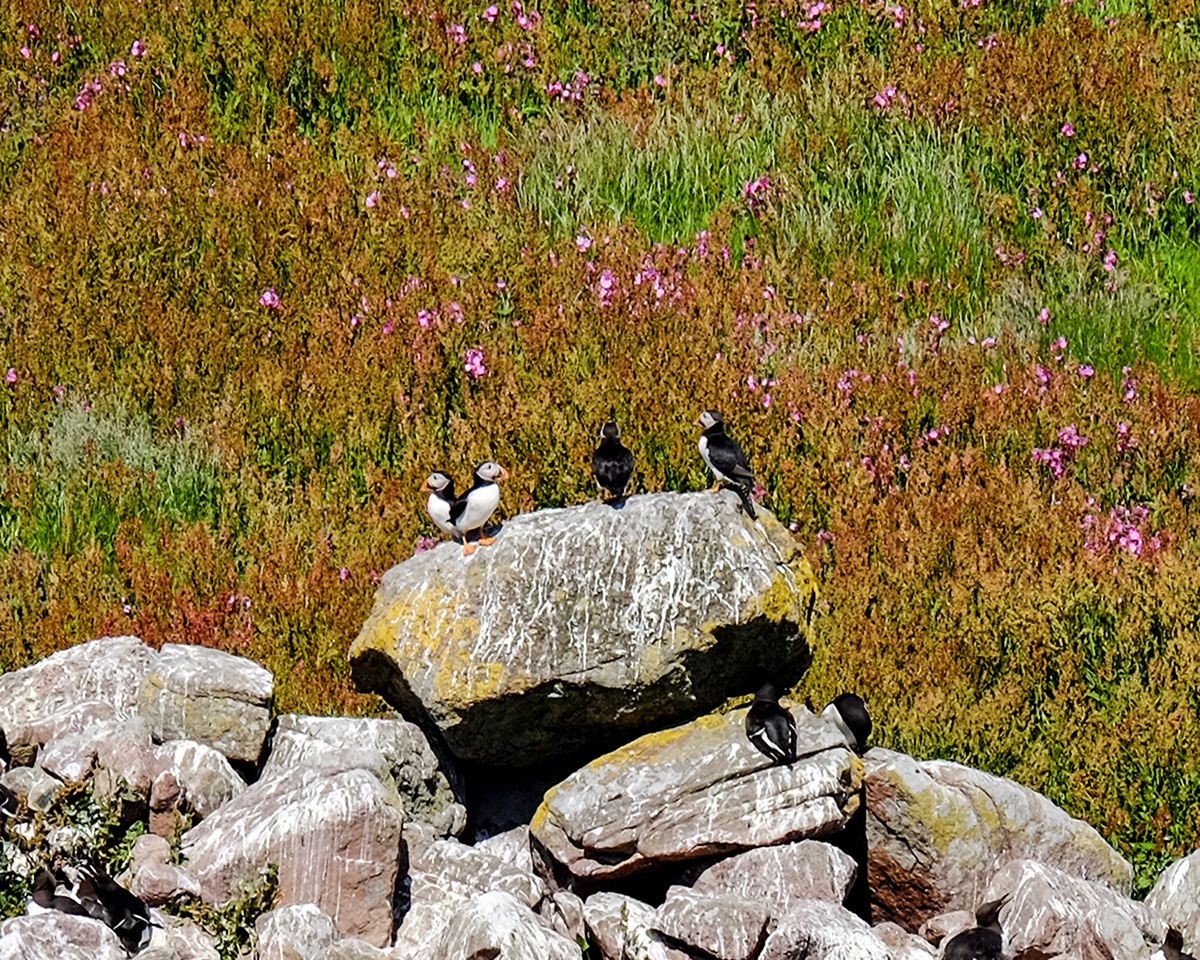
See puffins on the Isle of May — puffins return to Scottish coasts in April and May. The Isle of May in the Firth of Forth and Bass Rock near North Berwick are world-class seabird colonies. Read my complete guide to exploring the Firth of Forth.
Visit St Abbs Head — this dramatic National Nature Reserve on the Berwickshire coast is home to thousands of nesting seabirds in spring — guillemots, razorbills, kittiwakes and more.
Enjoy traditional folk music — two of Scotland’s best folk festivals take place in spring: the Mull Music Festival and the Orkney Folk Festival. Both are intimate, friendly events in extraordinary island settings.
See the cherry blossoms — Edinburgh’s Meadows park is transformed by a canopy of pink and white cherry blossom in late April and early May. Parks and gardens across Scotland put on their own displays throughout the season.
For a full calendar of events, see my complete guide to May 2026.
Where to stay in Scotland in spring
Spring is an excellent time to find availability and value in Scottish accommodation. With summer’s peak demand still weeks away, you’ll have more choice and often better prices, particularly at smaller rural hotels and self-catering properties that were closed over winter.
Keep in mind that many smaller hotels, B&Bs and self-catering cottages outside the cities reopen on or around 1 April, so if you’re travelling in March your choices may be more limited – book ahead and check directly with properties. During the Scottish school Easter holidays (usually late March to mid-April), popular destinations like the Isle of Skye and the Cairngorms will be busier and accommodation fills up quickly.
For the best spring experience I’d suggest basing yourself in a central location, Perthshire, for example, is brilliant for day trips to the Highlands, Edinburgh and Stirling. On the west coast, Oban makes an excellent spring base with ferry connections to the islands.
Discover the best places to stay in Scotland with my guides.
Scotland spring weather: what to expect month by month
Scottish weather is famously unpredictable, so here’s a realistic picture of what to expect across the three spring months.
One useful tip: the east coast (Edinburgh, Fife, Angus) tends to be drier and sunnier than the west coast (Glasgow, Argyll, Skye), which is wetter but milder thanks to the warming influence of the Gulf Stream.
March weather in Scotland
Average temperatures: 3–10°C (37–50°F). Daylight: approximately 10–12 hours.
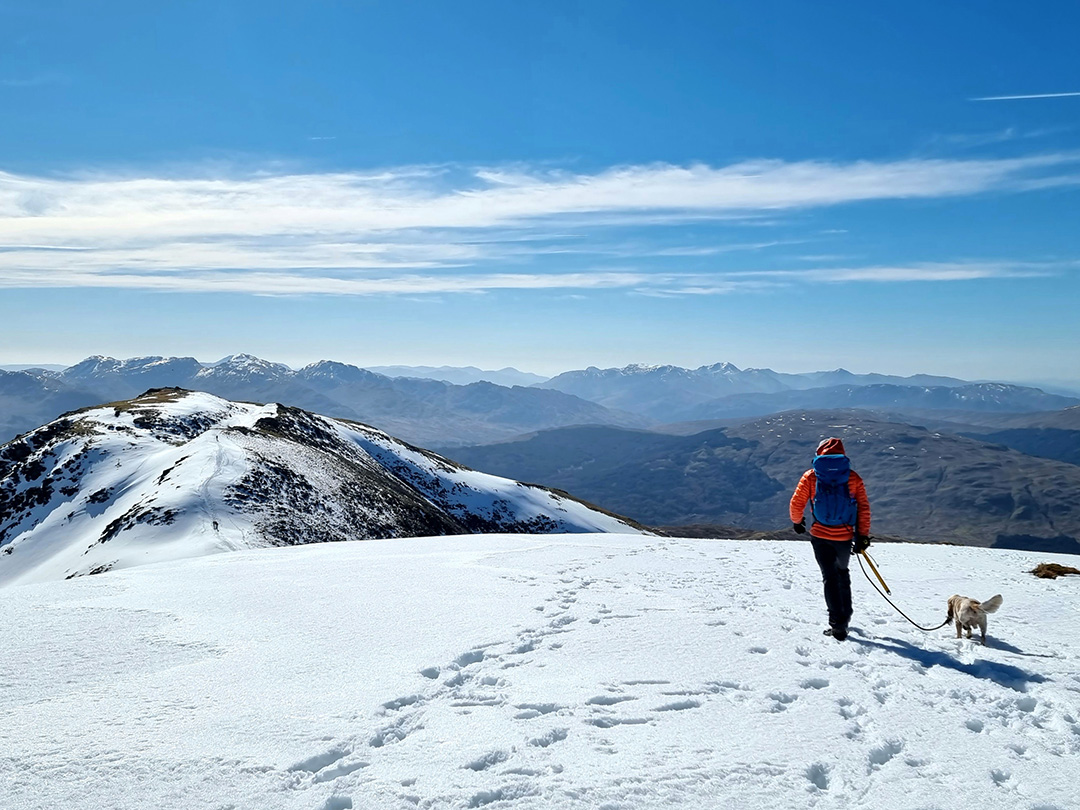
March still has a wintry edge, especially in the Highlands where snow is common on the mountains and can occasionally reach lower ground.
That said, March regularly delivers crisp, clear days with brilliant sunshine – and the light at this time of year is extraordinary.
The clocks go forward in Scotland on the last Sunday in March, giving an extra hour of evening light.
April weather in Scotland
Average temperatures: 6–13°C (43–55°F). Daylight: approximately 13–15 hours.
April has a reputation for showers and while you will likely be caught in a quick rain shower at some point, April is actually one of Scotland’s statistically drier months.
Expect changeable conditions with sunny spells between showers, and carry a lightweight waterproof at all times. Snow is still possible at altitude in the Cairngorms.
May weather in Scotland
Average temperatures: 9–16°C (48–61°F). Daylight: approximately 16–17 hours.
May is reliably the warmest and most settled spring month.
The end of May and early June are often Scotland’s most ‘summery’ weeks – on good years temperatures can reach 20–23°C (68–73°F) and you’ll be genuinely tempted to sunbathe.
Long evenings are a real joy, with daylight stretching until after 9pm in the north.
What to wear in Scotland in spring
The key principle for dressing in spring Scotland is layers. Conditions can change quickly, you might start a walk in sunshine and finish it in a squall, so being able to add and remove layers is essential.
For cities (Edinburgh, Glasgow, Inverness):
- A lightweight waterproof jacket — wind and rain can appear with little warning
- Comfortable walking shoes (cobblestones in Edinburgh make heels inadvisable)
- Mid-layer fleece or knitwear for evenings
- Note: umbrellas are largely useless in Edinburgh’s wind
For the Highlands and countryside:
- Good waterproof hiking boots – essential for any walking or hiking
- Base layer in merino wool – warm and quick-drying
- Mid layer – thin fleece or technical fabric
- Outer layer – a proper waterproof and windproof jacket (look for Gore-Tex or Nikwax-treated fabrics)
- Lightweight waterproof trousers that pack small
- Hat and gloves for March and higher elevations
For a full packing list covering every season and every type of trip in Scotland, including gear for families and city breaks, see my complete Scotland packing guide.
How much daylight is there in Scotland in spring?
Scotland sits at a similar latitude to Moscow and southern Alaska, which means daylight hours change dramatically across the seasons.
In deep winter you might have only 7 hours of usable light in the Highlands; by midsummer you get almost 18. Spring is the upswing and it’s one of the most exciting parts of living here.
- Early March: around 10 hours of daylight
- Late March: around 12 hours of daylight (clocks go forward)
- April: 13–15 hours of daylight
- May: 16–17 hours of daylight
By late May in the far north of Scotland (Shetland, Orkney) the sky barely gets truly dark at all. The long evenings of spring and summer are one of Scotland’s great underrated pleasures.
Frequently asked questions about spring in Scotland
When is spring in Scotland?
Spring in Scotland runs from March to May. The meteorological spring begins on 1 March; the clocks go forward by one hour on the last Sunday of March.
Is spring a good time to visit Scotland?
Spring is one of the best times to visit Scotland. You get fewer crowds and lower prices than summer, no midges, a full calendar of events, beautiful wildflowers and wildlife, and often excellent weather – particularly in April and May.
Does it snow in Scotland in spring?
Yes, snow is still possible in March, especially in the Highlands and at altitude. The mountains often carry snow well into April – which makes for spectacular scenery. Snow at lower levels is less common from April onwards but not unheard of.
Is spring the shoulder season in Scotland?
Yes – spring and autumn are Scotland’s shoulder seasons, making them generally cheaper and quieter than the peak summer months.
The exception is the Scottish school Easter holidays (usually late March to mid-April), when popular destinations get busier and accommodation prices rise temporarily.
What are the best places to visit in Scotland in spring?
The Isle of Skye, the North Coast 500, Glencoe, Perthshire, the Cairngorms National Park, Fife, and the Scottish Borders are all outstanding in spring.
Edinburgh is wonderful in spring too – a little bit quieter than summer, with cherry blossoms and festivals in full swing.
Ready to plan your spring trip to Scotland?
Whether you’re chasing puffins on a Fife clifftop, raising a dram at a Speyside distillery, or simply driving a Highland pass with the windows down and the mountains glowing in evening light, a spring visit is one you’ll want to repeat every year.
Save this guide, share it with a fellow Scotland-lover, and start planning. And if you have questions, drop them in the comments below – I’m always happy to help.
Love from Scotland x
You might also enjoy: